In early August 2025, my friend Paul (BirdsGV), was kind enough to help / teach me how to build my own Raspberry Pi birdsong listening station … a small computer which after being built and configured runs BirdNET-Pi (learn more about these birdsong listening stations). Well … Paul has created a monster! I have now built many, many more of these devices. Some of the birdsong devices are fixed in location, and others are mobile which allows the stations to be placed deep in the northern Minnesota wilderness for research purposes.
Even without a BirdNET-Pi, anyone may use the BirdWeather service to research what birds are singing at a desired geographic area (free and no account required). This blog post has screenshots which I took and then annotated from BirdWeather. The images demonstrate the ease of using BirdWeather. I personally used BirdWeather BEFORE my recent trip to Ireland. My goal (achieved) was to learn what species of birds should be the focus of my birding efforts in Ireland’s Skellig Region. In fact, birdsong listening stations listed via BirdWeather may be compiled across both specific regions and custom timelines.
Here in northeastern Minnesota my desire was to bring online BirdNET-Pi stations which were strategically placed either in key habitat or along bird migration highways. Thankfully I have good friends who agreed to let me make the stations I built for them public via BirdWeather. Here are eight stations with a brief description of the bird habitat: (just below this map of where the birdsong listening stations are located)
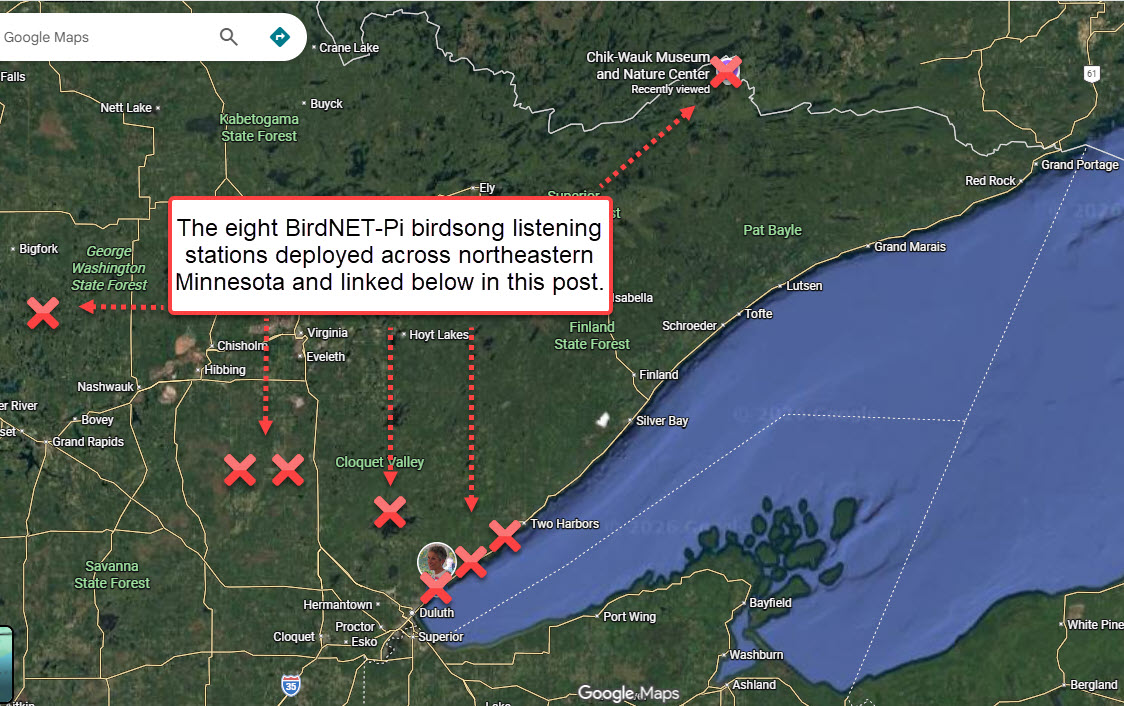
If you press upon the link to any of these birdsong listening stations, you will be directed to that specific BirdNET-Pi station. BirdWeather always defaults to the last 24 hours of birdsong for any station and the service works much better if you are on a more powerful computer with a larger screen. Smaller mobile devices like phones are challenged by the interface and memory requirementsl
- Amity Creek & Gardens – 800 yards upstream from Lake Superior … Boreal Forest at the edge of an urban area … one mile below Hawk Ridge (Private Land)
- Boulder Lake Environmental Learning Center – Boreal Forest lakefront habitat with nearby ponds and wetlands within listening range of the device (a bit north of Duluth). Web Site.
- Chik-Wauk Nature Center – Boreal Forest lakefront habitat with nearby ponds and wetlands within listening range of the device (at the end of Gunflint Trail extremely near to the Canadian border … inland from Grand Marais, Minnesota). Web Site.
- French River Lutheran Church – French River is located on Ryan Road just inland from the big lake and about one mile up the shore and Scenic 61 from McQuade Harbor. The church’s property abuts French River (hiking trails from parking lot to river. The habitat is Boreal pine and cedar forest. The church even maintains public bird feeders every winter … just watch out for pre-school children!
- Mouth of the Sucker River – Boreal Forest at the mouth of the Sucker River about 1/2 way between Duluth and Two Harbors (Private Land)
- Northstar Lake – Boreal Forest on a deep spring-filled lake 30 miles north of Grand Rapids. The lake is the most southern lake of the Hudson Bay Watershed (Private Land)
- Sax-Zim Bog on Kelsey Whiteface Road – Boreal Forest very near the Whiteface River about 1 mile south of Arkola Road and in a few hundred yards from Highway 7 and Kelsey-Whiteface Roads (Private Land)
- Sax-Zim Bog on Owl Avenue (Welcome Center) – The Friends of Sax-Zim Bog Welcome Center is located on Boreal forest bog habitat. Web Site.
Note: The Sax-Zim Bog BirdNET-Pi Listening Stations and Research Project is sponsored by the Friends of Sax-Zim Bog. The project is dedicated to, and in memoriam of my dear friend and birding buddy, Pastor Greg Garmer. In addition to my financial donation to the Friends of Sax-Zim Bog, I have committed to building their stations (permanent and field research) and teaching the staff how to build, configure / use the Raspberry Pi stations.
Geographically these birdsong listening stations allow one to understand what birds are singing “on location” in northern Minnesota, but also learn how the spring and fall migrations are progressing.
Remember … these BirdWeather BirdNET-Pi Stations (or any station) allow you to customize your desired time period. BirdWeather stations are found THROUGHOUT world.
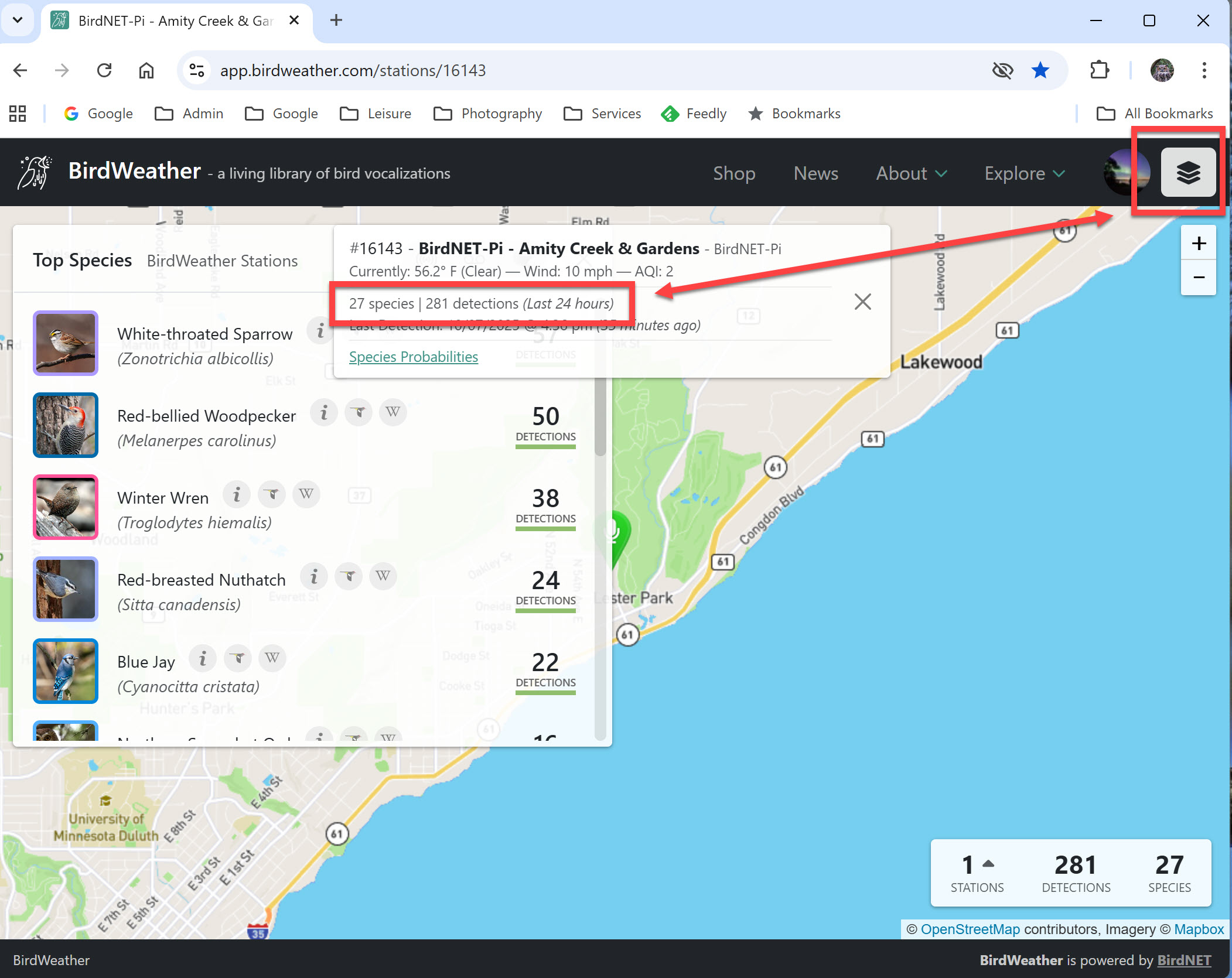
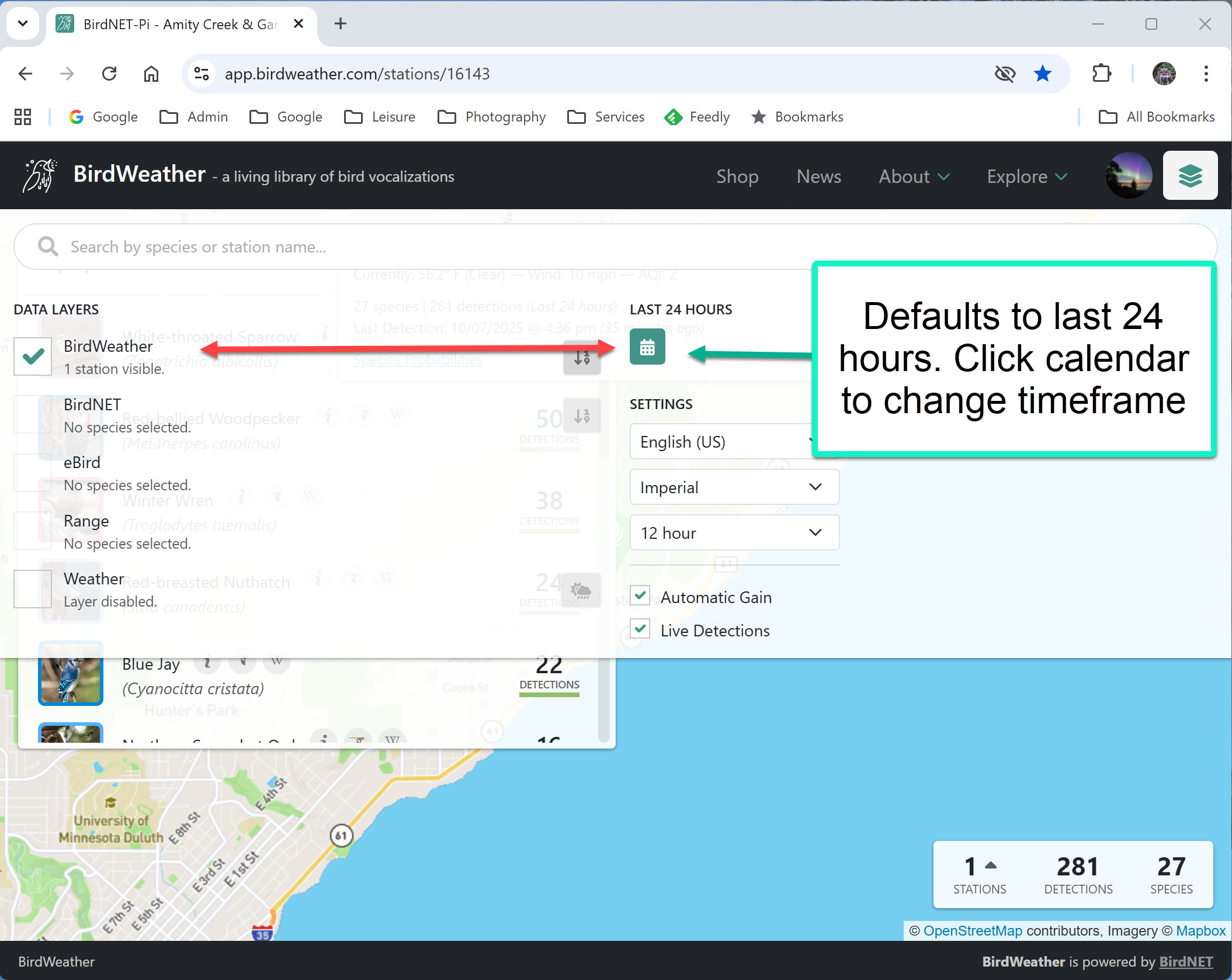
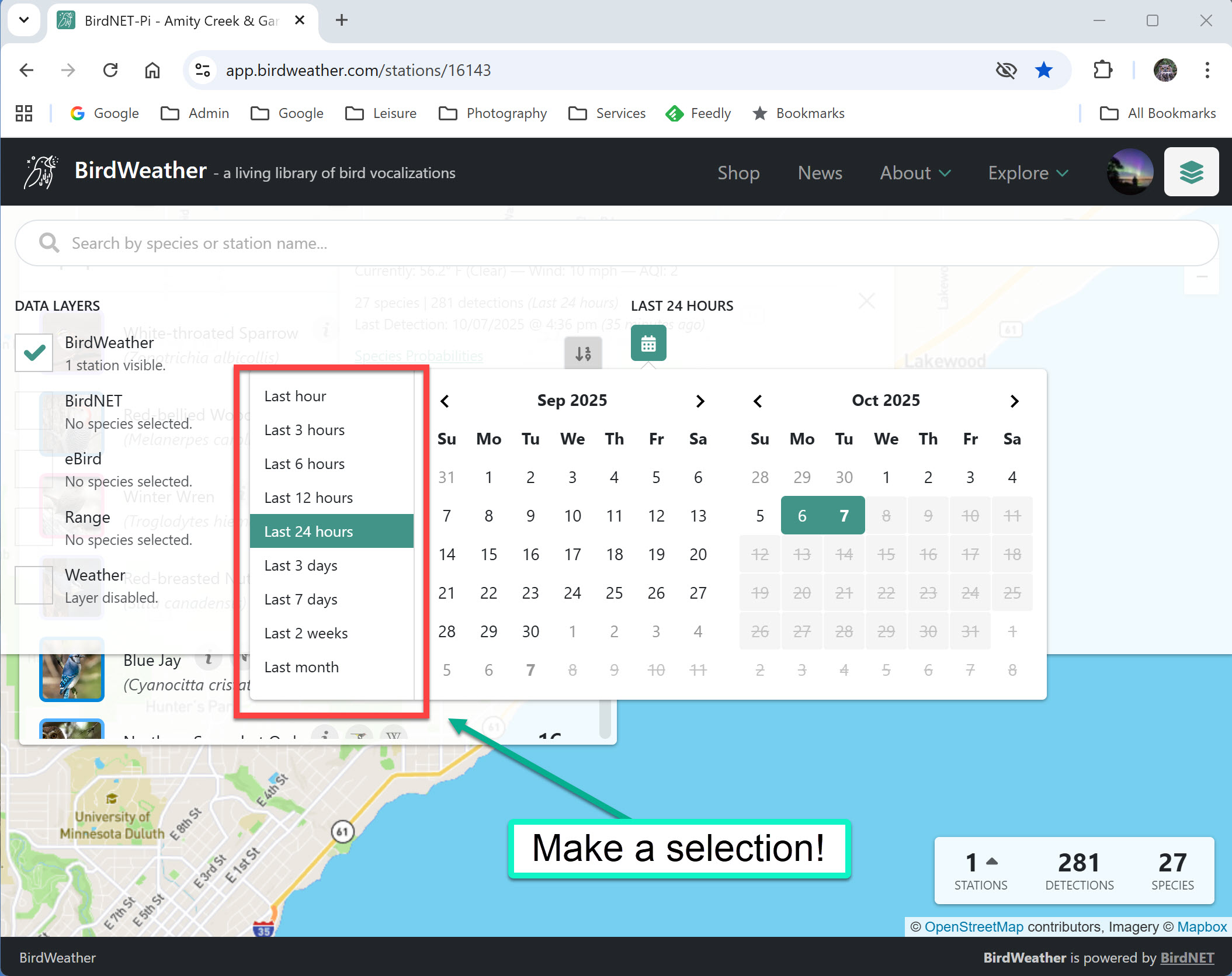
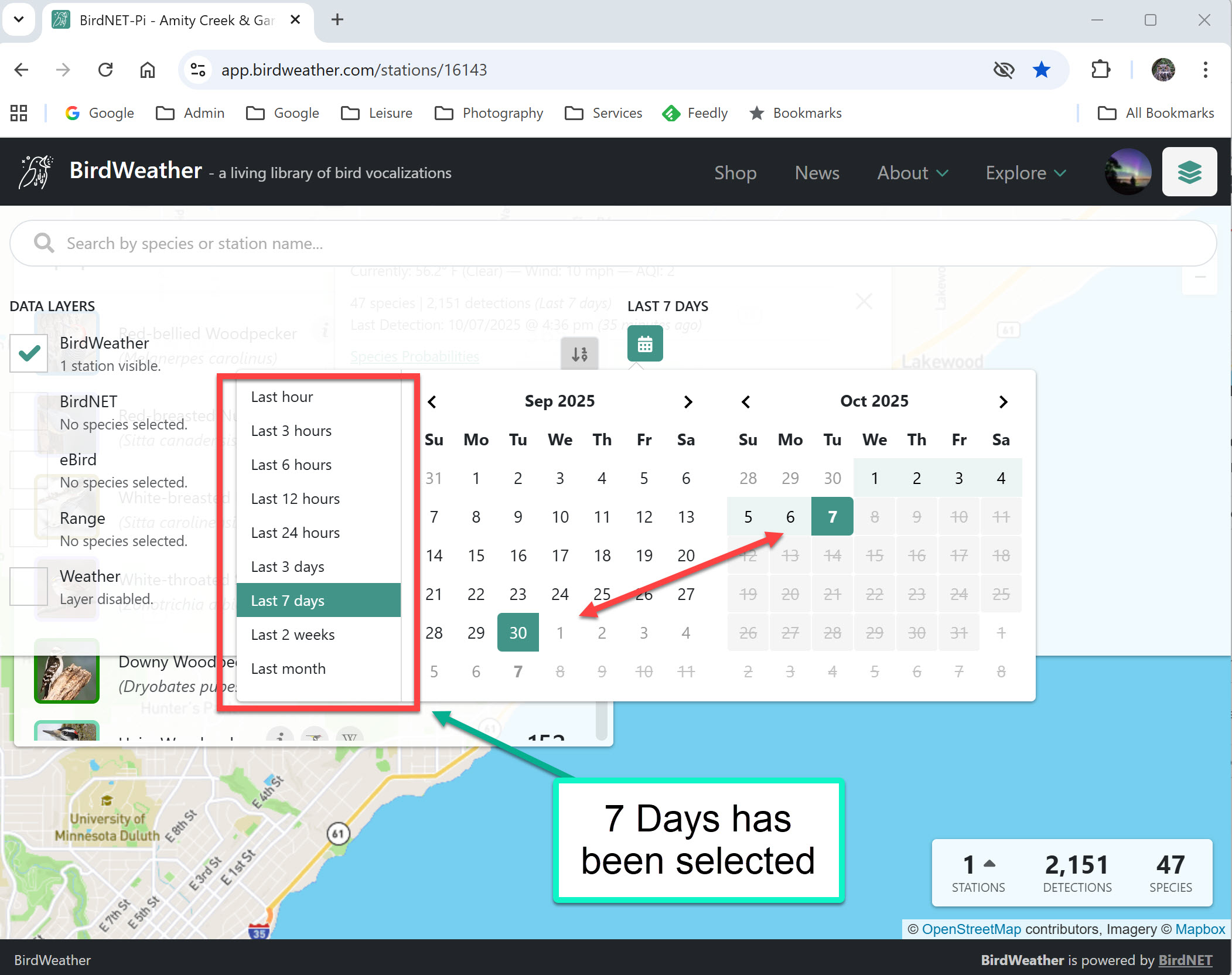
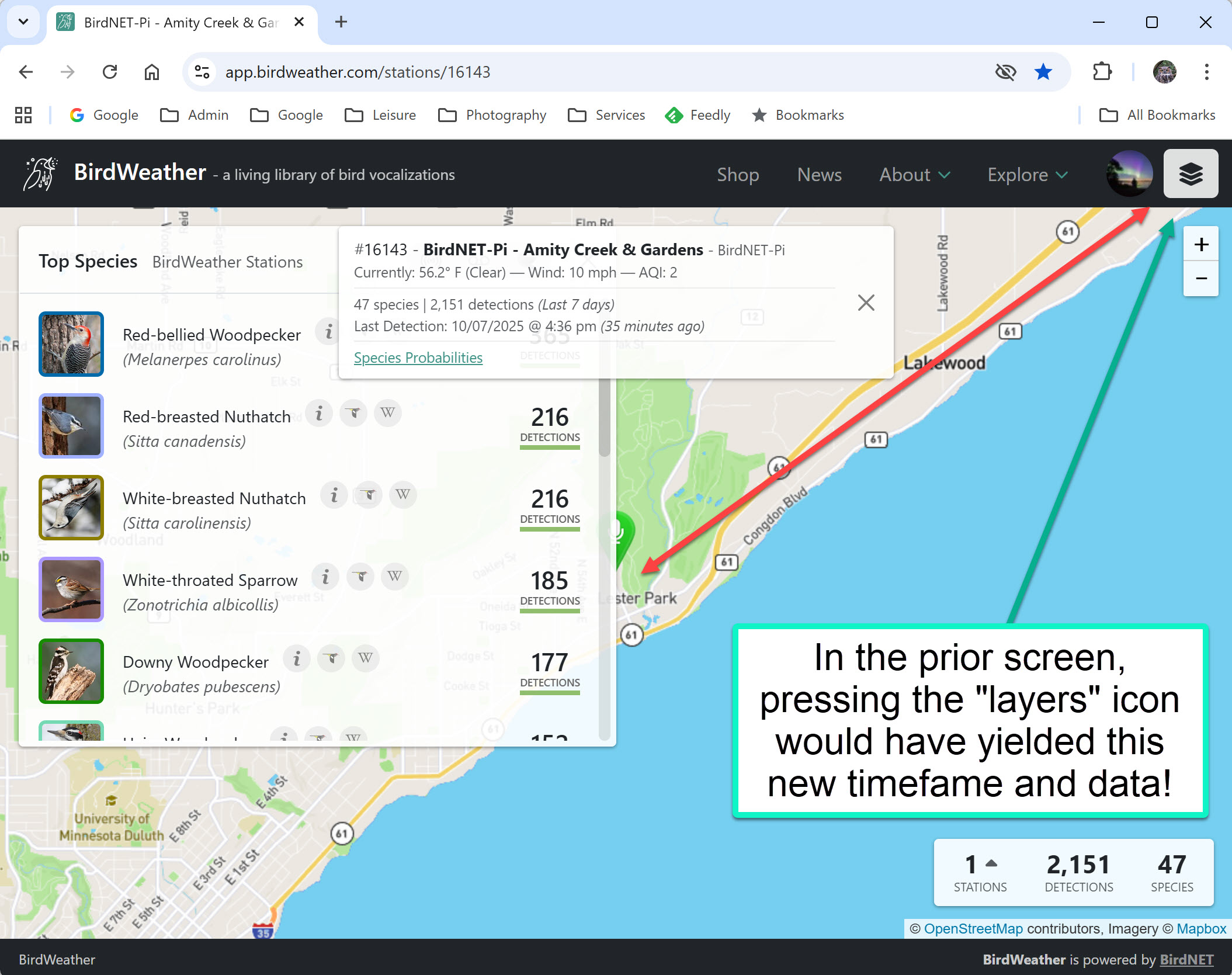
Changing the desired timeframe for a specific BirdWeather BirdNET-Pi Station.
You will know your result is only ONE station if the url ends with a unique station number … in my case 16143
Amity Creek & Gardens BirdNET-Pi via Birdweather
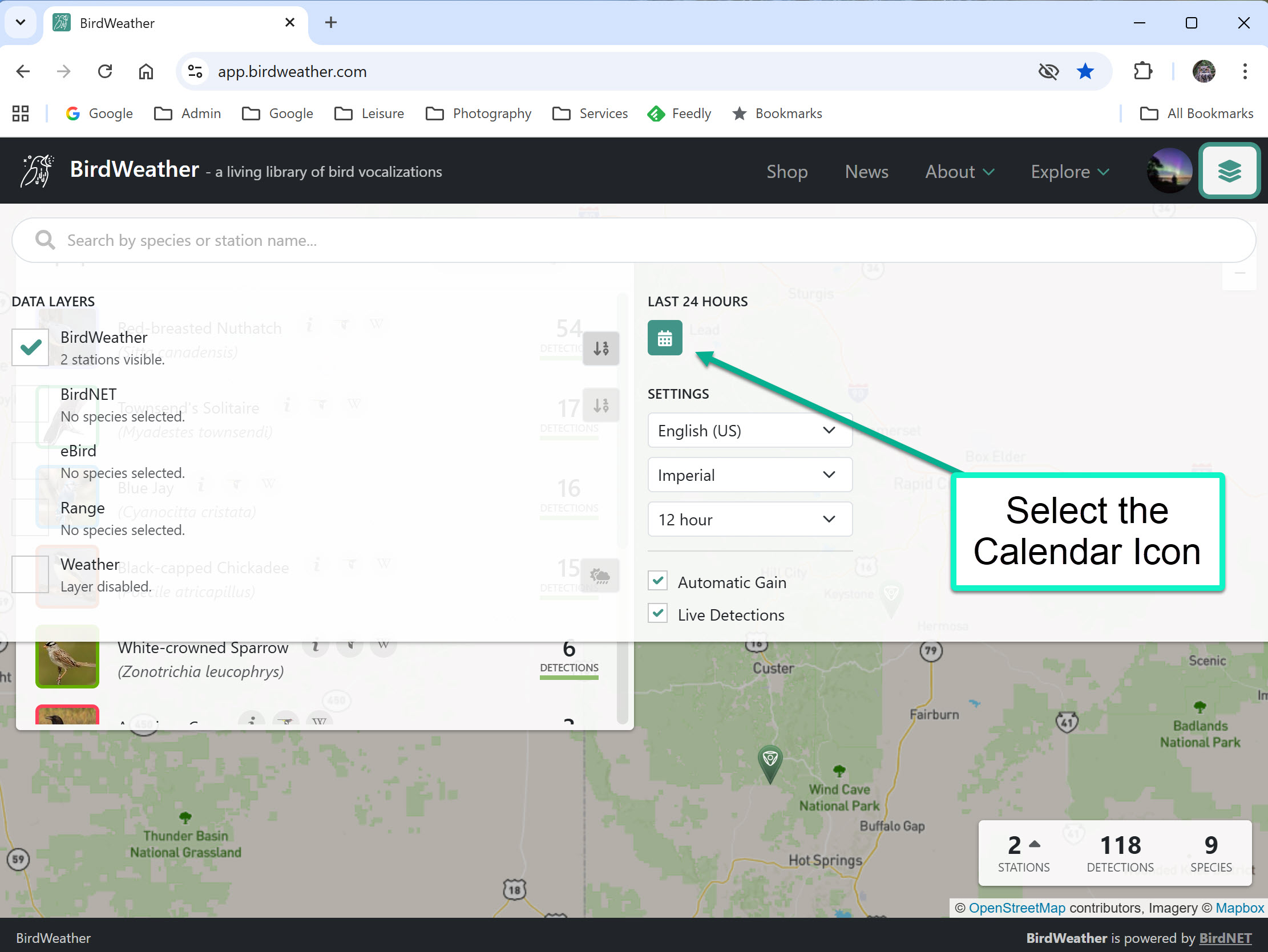
In this example “the key” is to select the “layers icon” both at the beginning and end of your “personal configuration”. Press / click upon any image to maximize.
BirdWeather works INFINITELY better when using a desktop or laptop computer. On tablets or phones the process is difficult. After selecting your data time periods, give the service a moment or two to update!
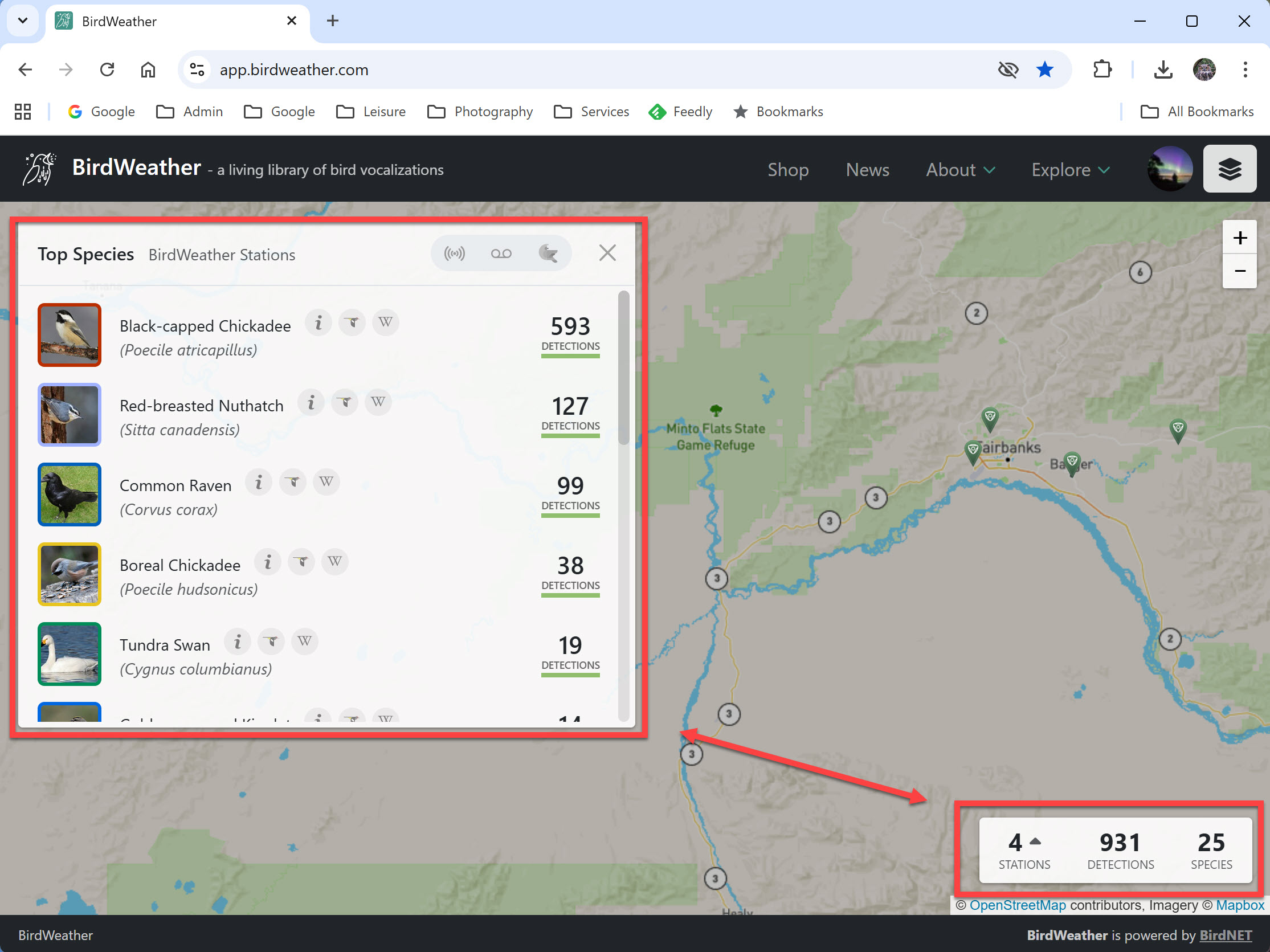
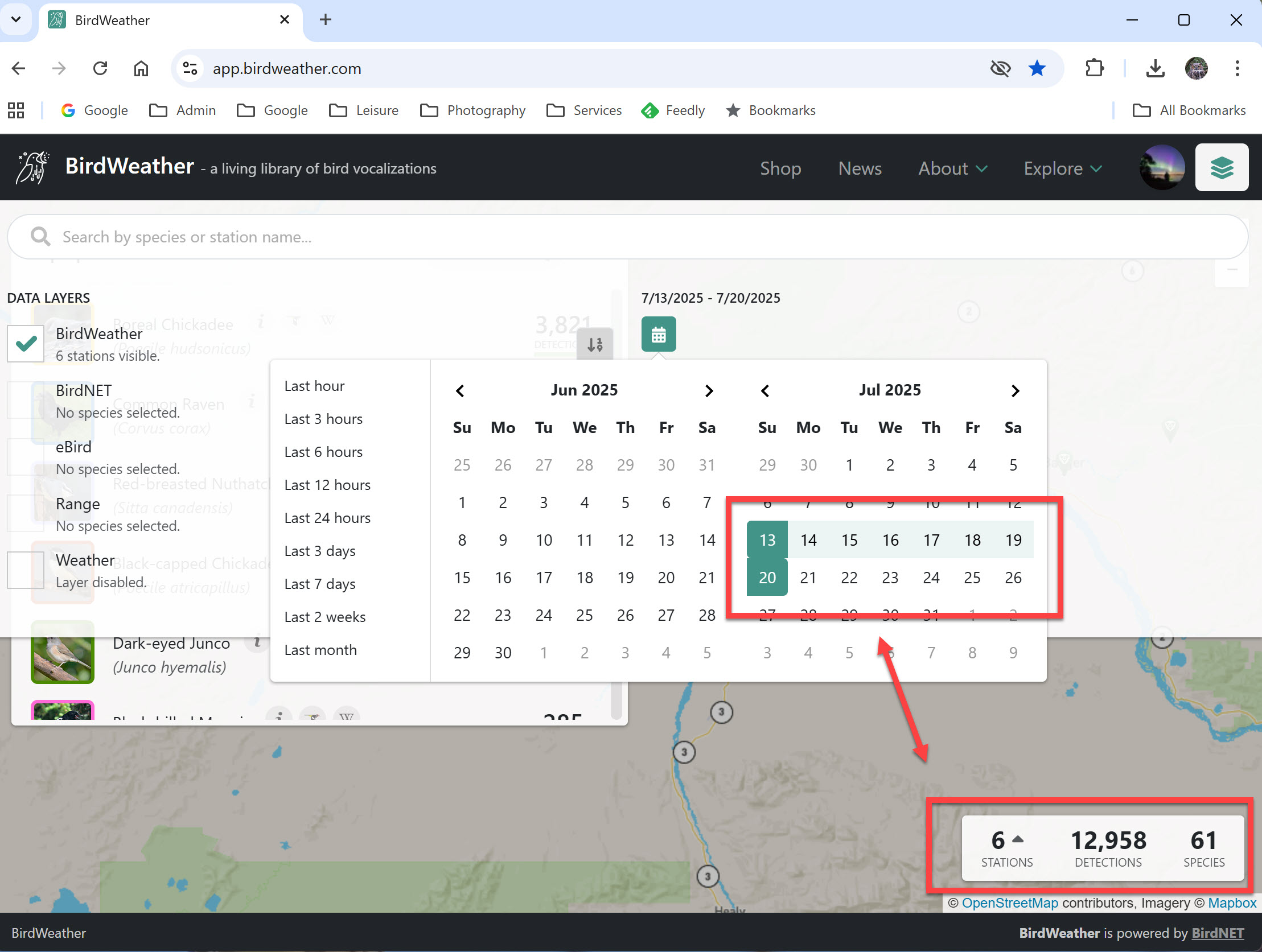
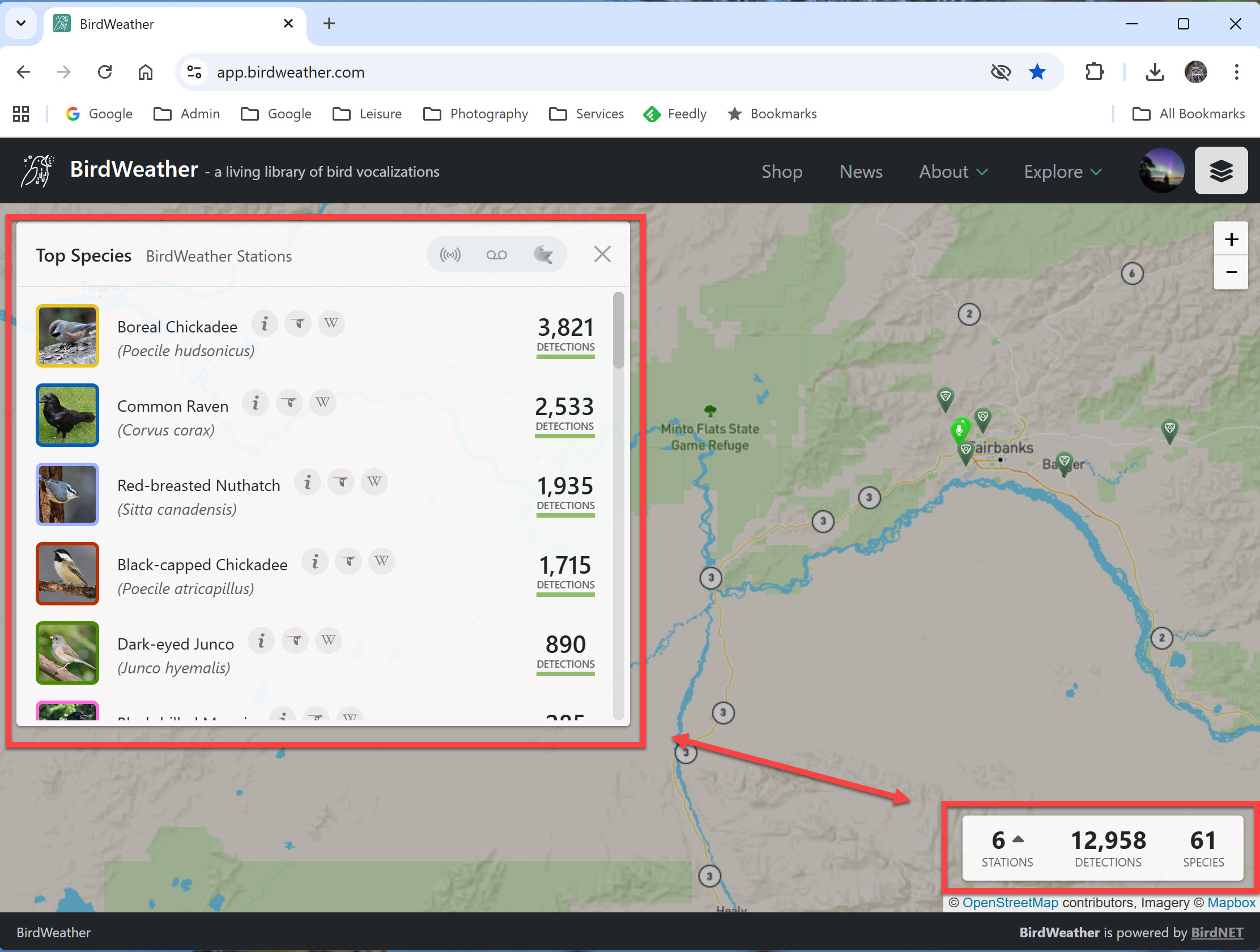
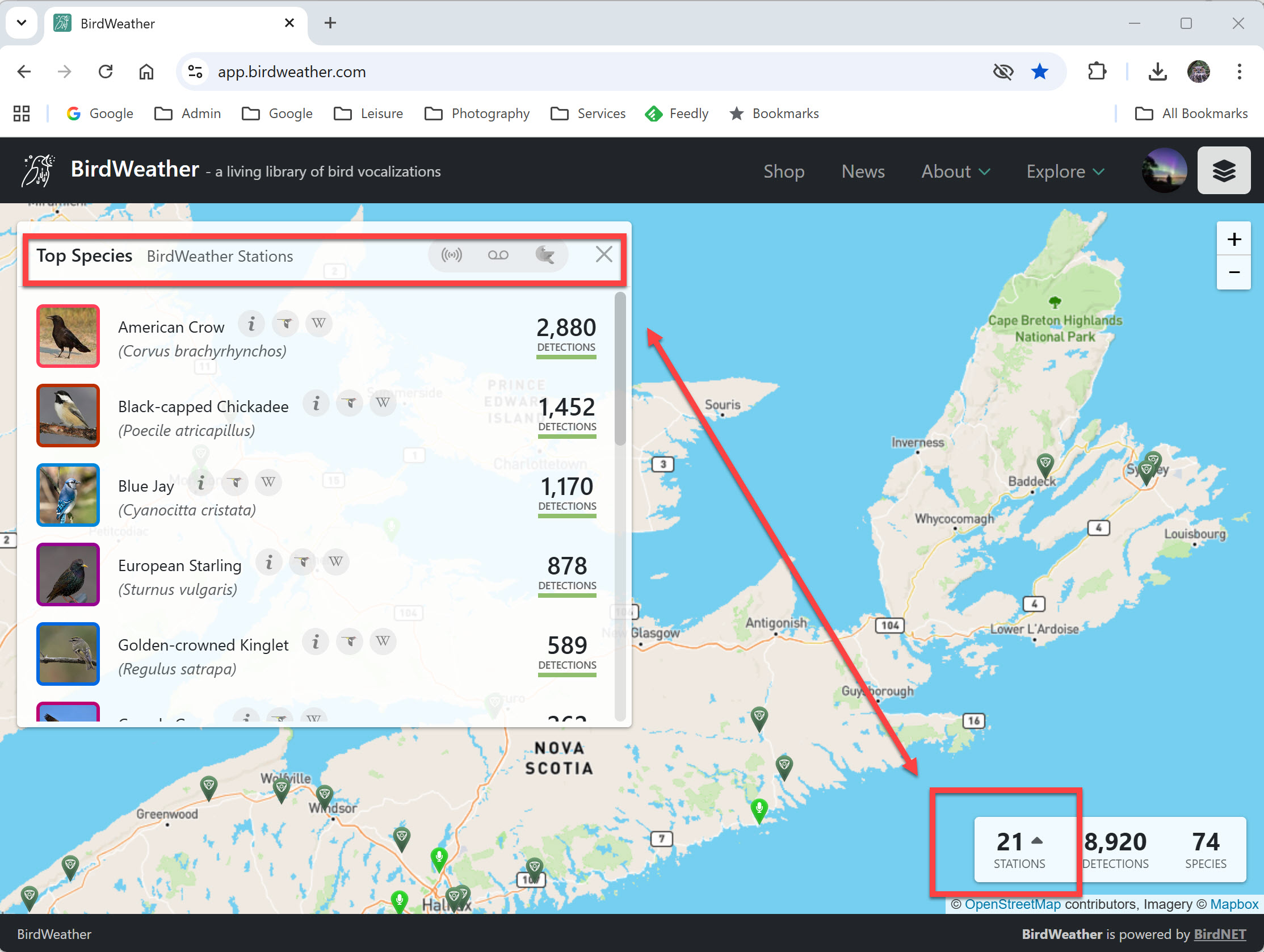
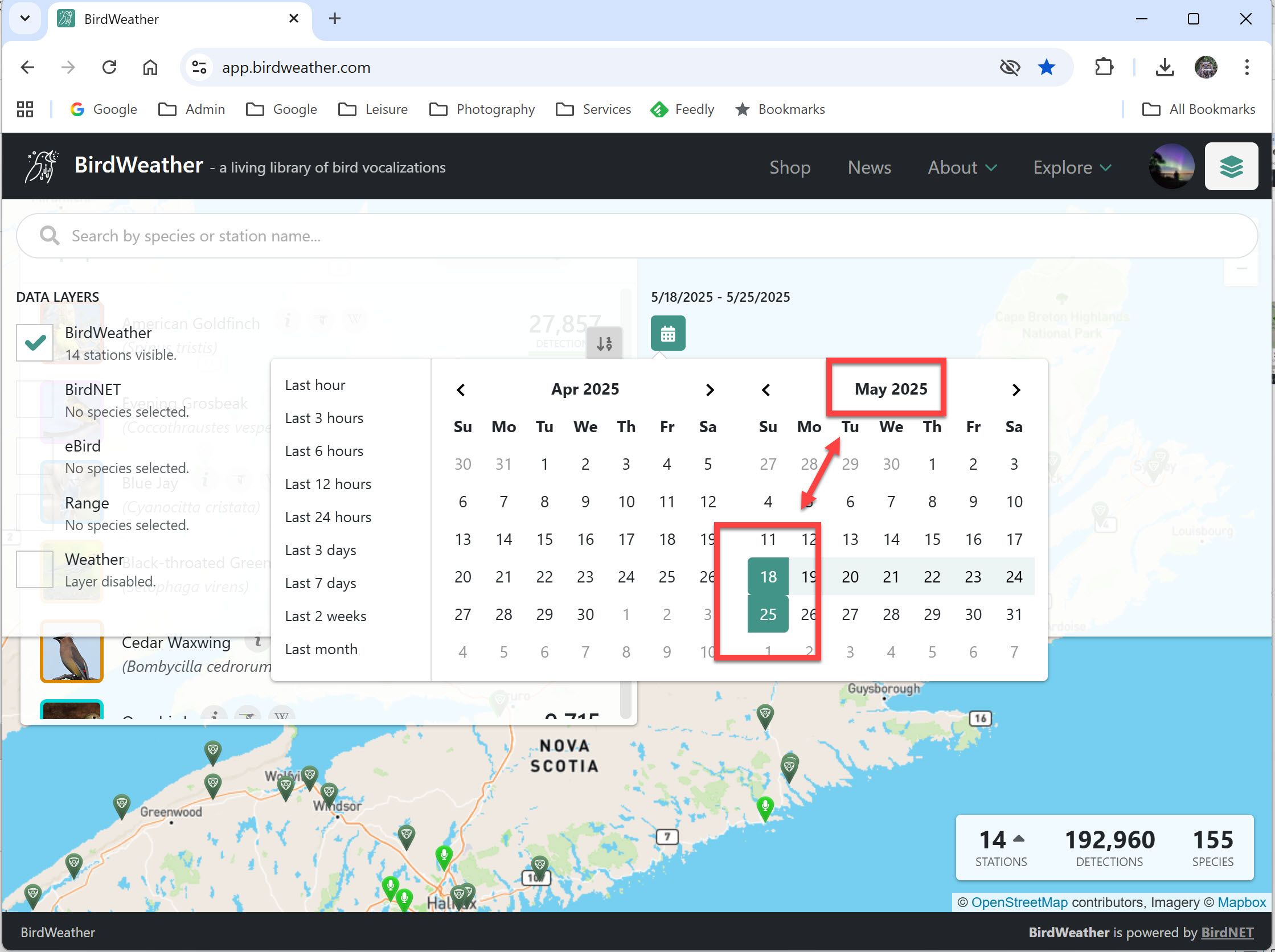
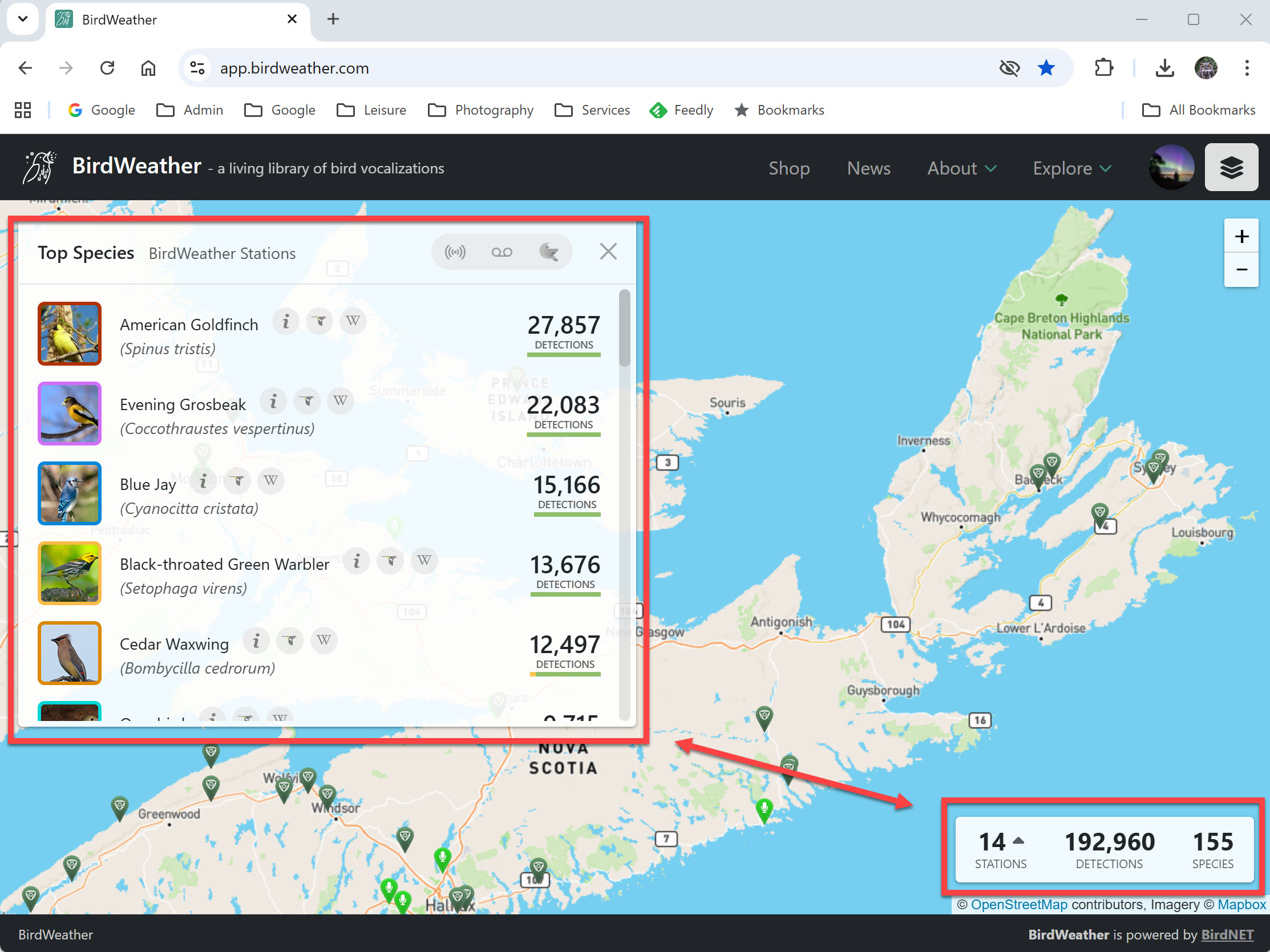
Here are two examples which assume you, the reader, want to bird a given area. For the sake of this exercise let’s assume next summer you want to visit either Alaska (Fairbanks area) or Nova Scotia. Using Birdweather one would select custom dates for the timeframe one year prior to your Summer 2026 visit! Navigate the calendars and select your dates. Notice how you are getting multiple BirdNET-Pi’s and PUCs. Thus, your data, if enough stations are selected, should be EXTREMELY accurate on what birds would be likely to be present next summer. BirdWeather will adjust your results based upon the actual active birdsong listening stations for a given timeframe.
Fairbanks Area (timeframe selected is in July 2025)
Nova Scotia (timeframe selected is in May 2025)
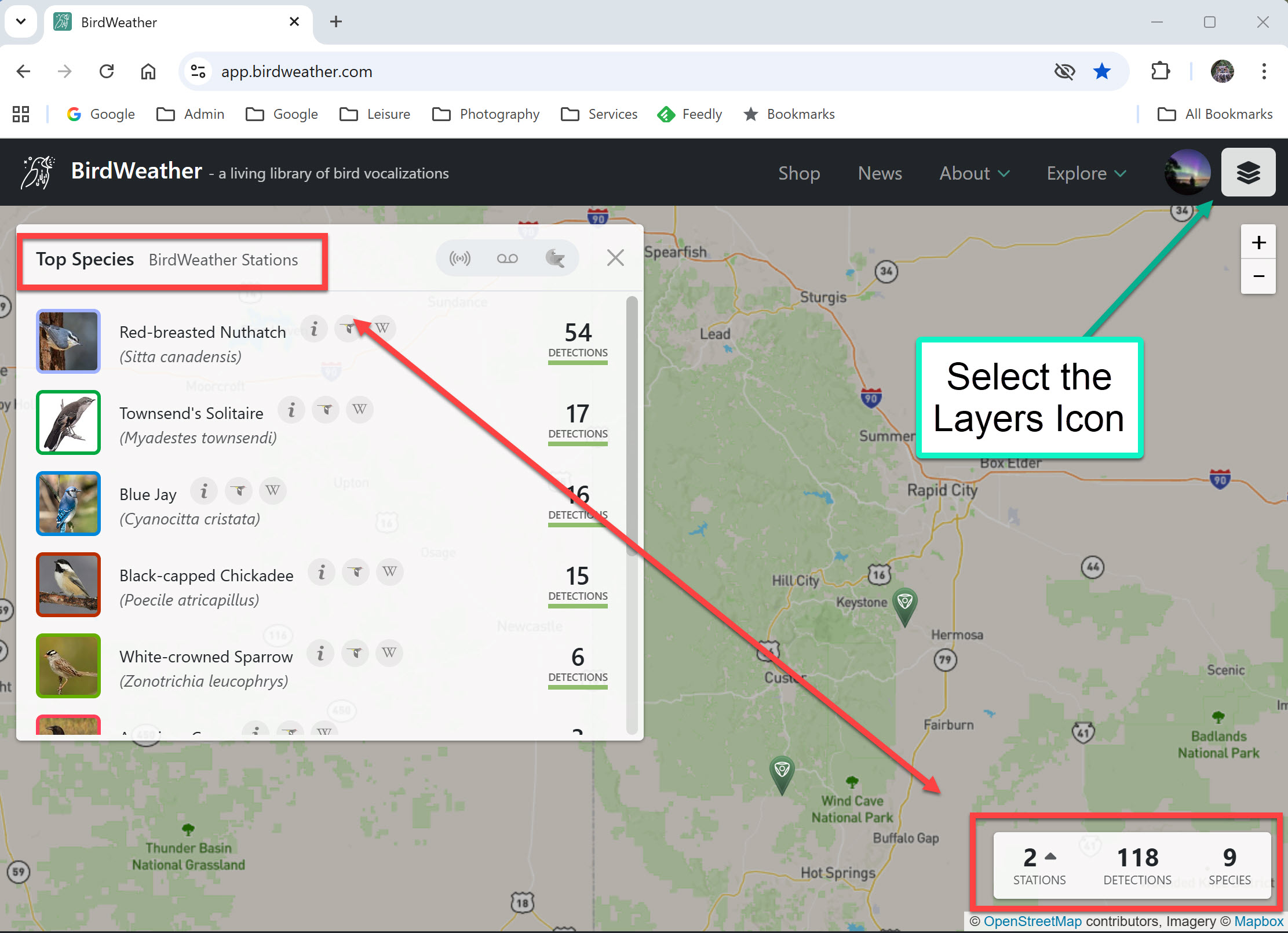
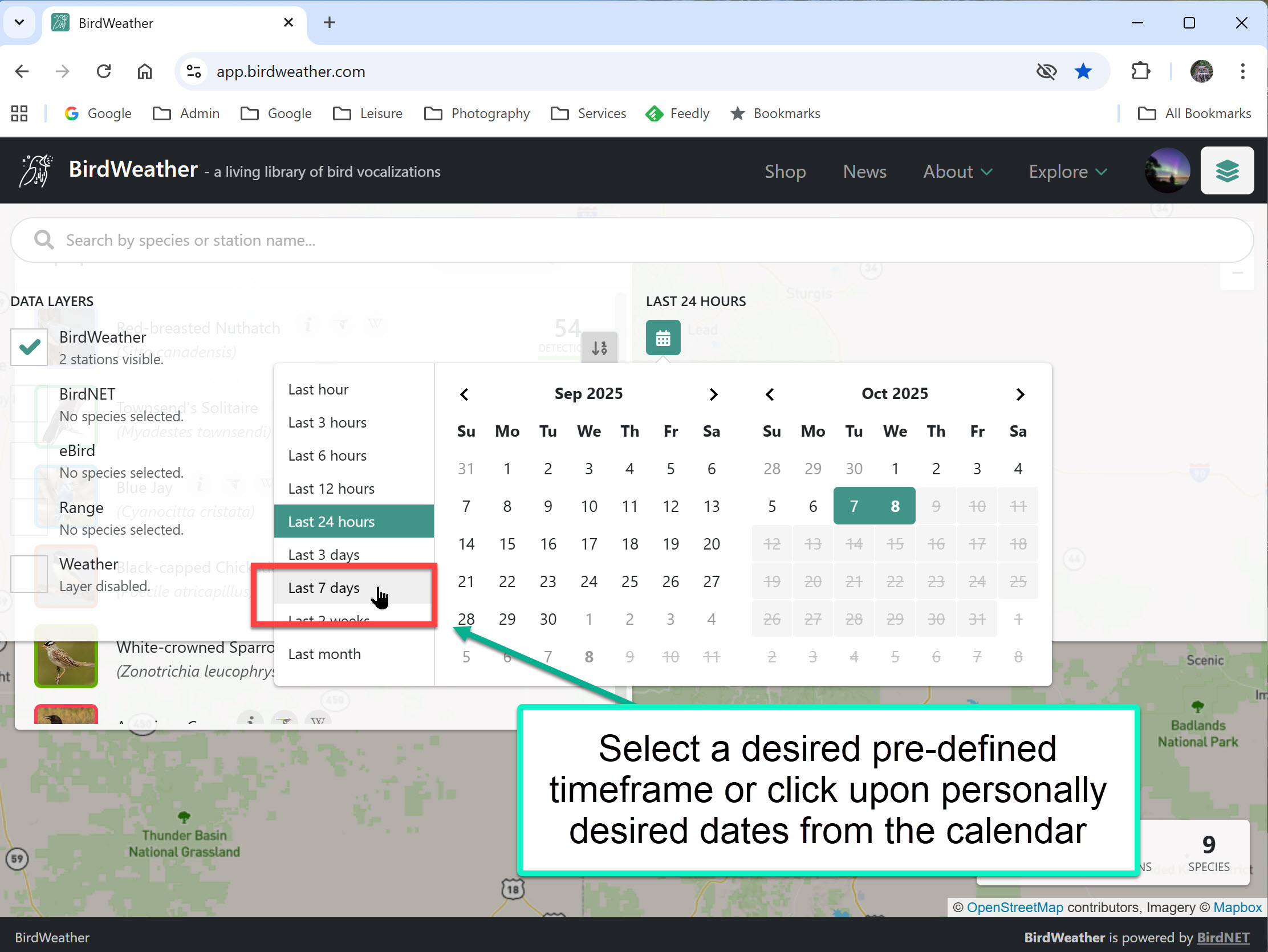
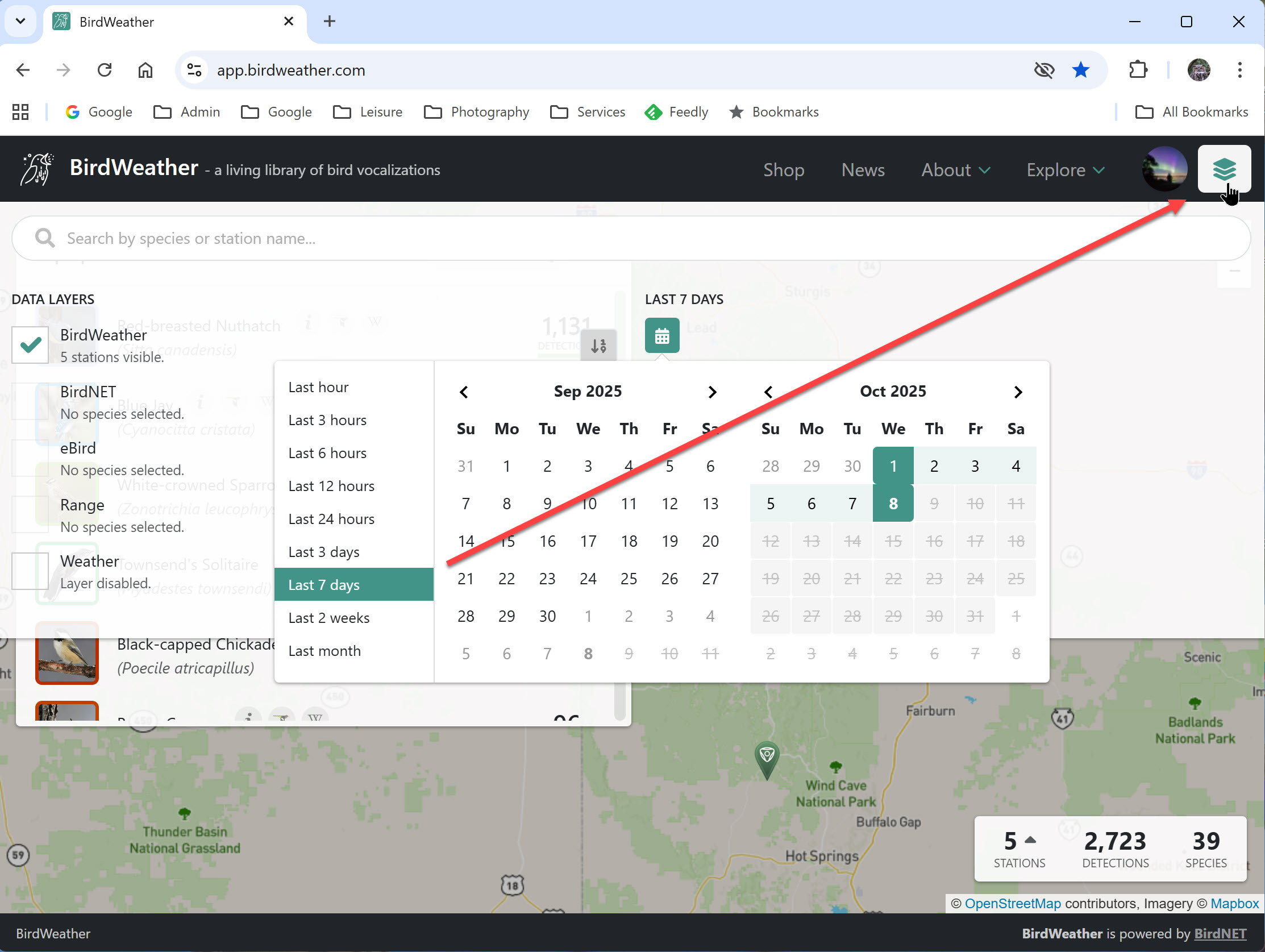
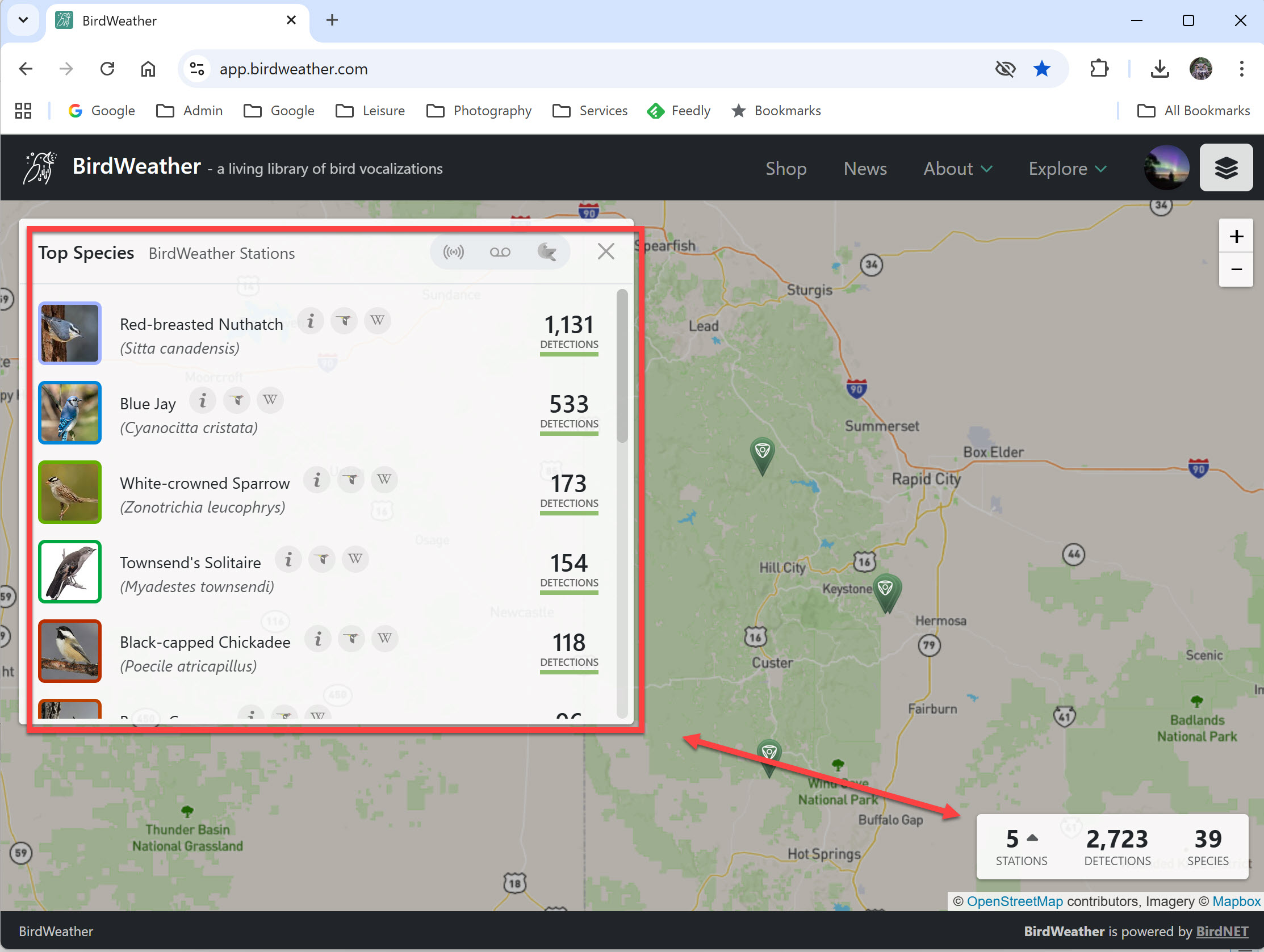
Here is one final example … let’s assume you would like to visit the Black Hills within a few days of today (October 10th when I was authoring this post).
- Browse to the BirdWeather’s Map of the USA
- Zoom in and out to find the Black Hills (or Ireland, or Costa Rice, etc)
- Try NOT to click upon any birdsong station while navigating. Birdweather will try to quickly give you that station’s data.
- As these regions are large, with a HUGE number of stations, the bird data will be constantly updating.
Black Hills, South Dakota (most recent week of data)
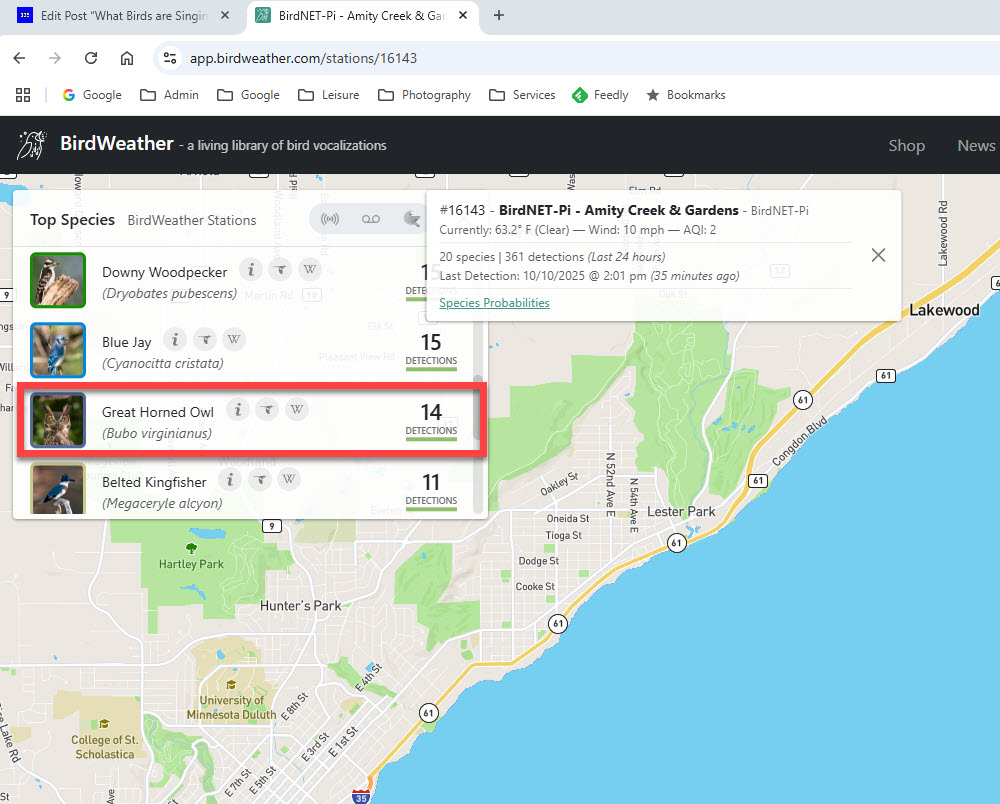
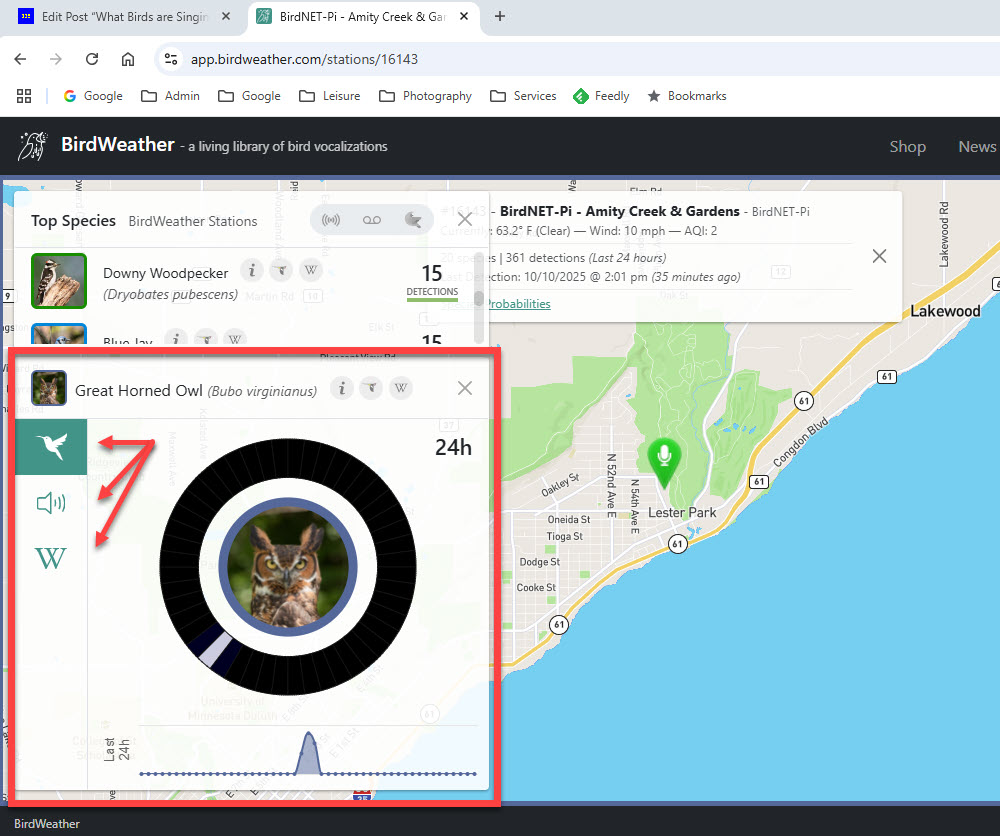
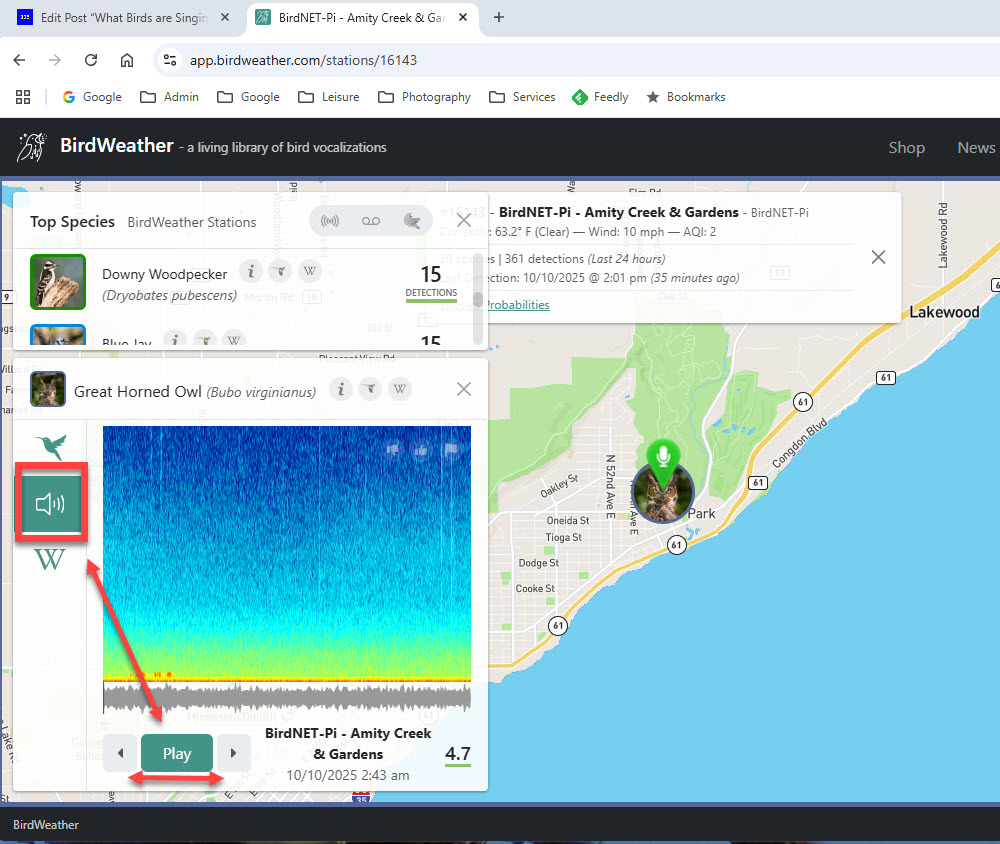
Hopefully you made it down to the bottom of this post. VERY, VERY IMPORTANT. You are actually able to listen to the birds … the actual sound recording(s) made by that specific / unique bird. In my example, the screenshots are for Amy, my Great Horned Owl which was hooting last night! You may also learn:
- the time distribution of the identifications
- more about the bird species via Wikipedia.
Amy! A Lovely Lady Who Hoots in the Night near Amity Creek!
End of Post