I have always taken the position that one should only use a PC (laptop or workstation) to view and listen to Bird Song ID’s Results displayed via App.BirdWeather.Com. When using a computer while the website loads, one just navigates to the desired station and clicks upon items with a mouse … no fuss, very little delay, no account necessary.
I was personally always frustrated that the use of a mobile device / cell phone did not seem to work for viewing BirdWeather stations … including all of the BirdNET-Pi stations which I have built and deployed. This frustration bubbled over once more with my work for the new Hawk Ridge BirdNET-Pi station (see my post). With a gentle nudge from the Hawk Ridge Research Director (thanks Emily!), I tried again to solve the “cell phone viewing problem”. Jackpot! The process is convoluted but it works. Review these annotated screenshots which demonstrate how to view the birdsong ID results (and if desired … listen) using your phone.
While one may use the entire map of the world via App.BirdWeather.Com to find a specific station, here are my favorite Northeast Minnesota BirdNET-Pi birdsong listening stations. Assuming you are on a phone, press on any station link (perhaps bookmark the station), and then follow the documented process.
Northeast Minnesota BirdNET-Pi Listening Stations (screenshots immediately follow)
- Amity Creek & Gardens – 800 yards upstream from Lake Superior … Boreal Forest at the edge of an urban area … one mile below Hawk Ridge (Private Land)
- Boulder Lake Environmental Learning Center – Boreal Forest lakefront habitat with nearby ponds and wetlands within listening range of the device (a bit north of Duluth). Web Site.
- Chik-Wauk Nature Center – Boreal Forest lakefront habitat with nearby ponds and wetlands within listening range of the device (at the end of Gunflint Trail extremely near to the Canadian border … inland from Grand Marais, Minnesota). Web Site.
- French River Lutheran Church – French River is located on Ryan Road just inland from the big lake and about one mile up the shore and Scenic 61 from McQuade Harbor. The church’s property abuts French River (hiking trails from parking lot to river. The habitat is Boreal pine and cedar forest. The church even maintains public bird feeders every winter … just watch out for pre-school children!
- Hawk Ridge Research Station – Running off the grid … still in test mode. Hawk Ridge stands almost 700 feet above Lake Superior at the Duluth end of the lake. Birds while migrating south run smack dab into the largest freshwater lake in the world. Birds then decide they do not wish to fly out over such a large body of water, and thus fly down the shoreline to either Whitefish Point at the eastern end or Hawk Ridge at the western end of Lake Superior. (restricted access … bird at the viewing area)
- Mouth of the Sucker River – Boreal Forest at the mouth of the Sucker River about 1/2 way between Duluth and Two Harbors (Private Land)
- Northstar Lake – Boreal Forest on a deep spring-filled lake 30 miles north of Grand Rapids. The lake is the most southern lake of the Hudson Bay Watershed (Private Land)
- Sax-Zim Bog on Kelsey Whiteface Road – Boreal Forest very near the Whiteface River about 1 mile south of Arkola Road and in a few hundred yards from Highway 7 and Kelsey-Whiteface Roads (Private Land)
- Sax-Zim Bog on Owl Avenue (Welcome Center) – The Friends of Sax-Zim Bog Welcome Center is located on Boreal forest bog habitat. Web Site.
Now that you have the direct link to my favorite birdsong listening stations, here are the screenshots … annotated with explanations.
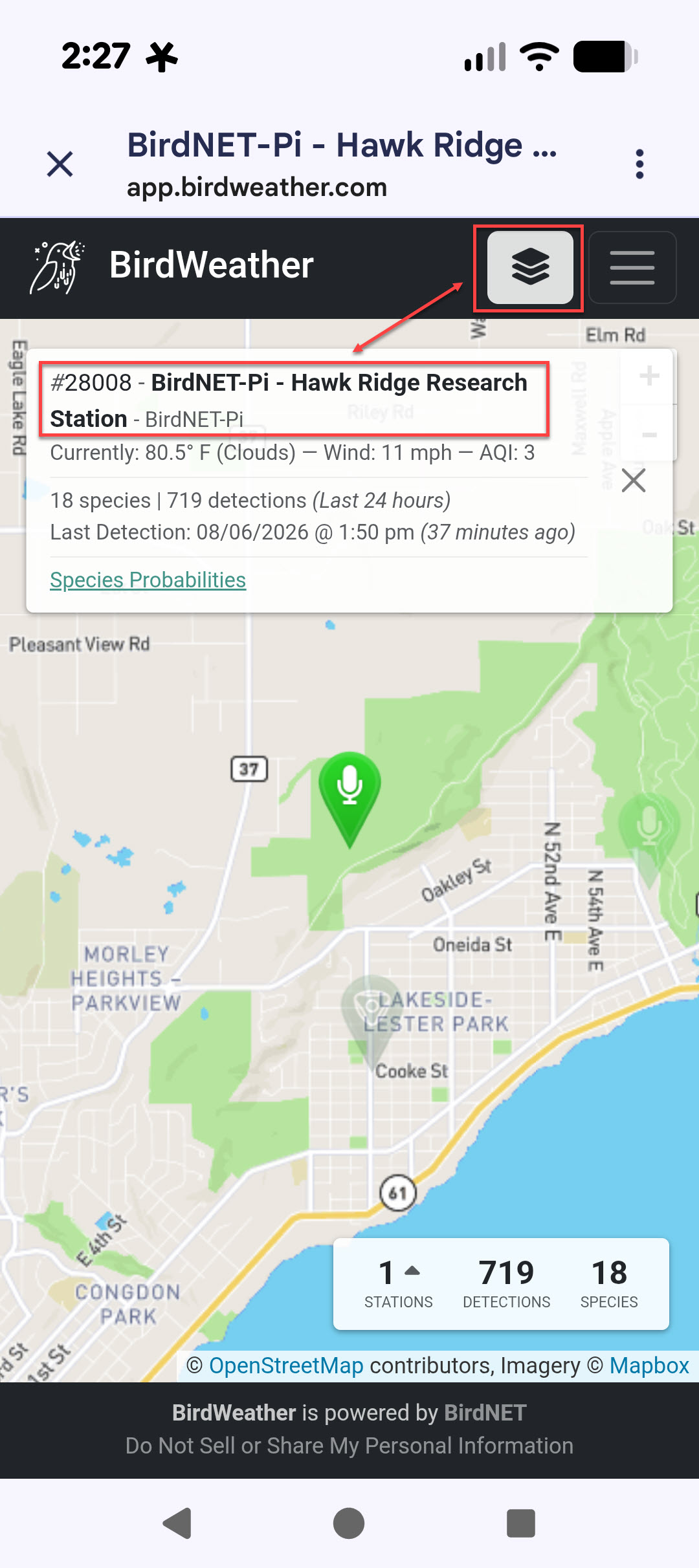
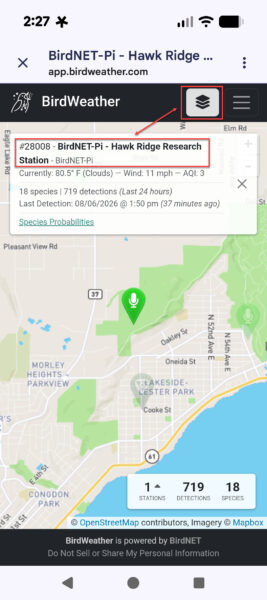
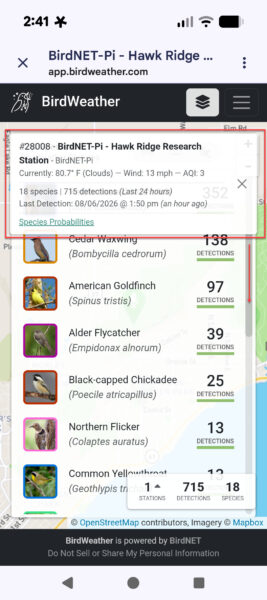
- Browse to your desired birdsong station. This example uses the Hawk Ridge BirdNET-Pi.
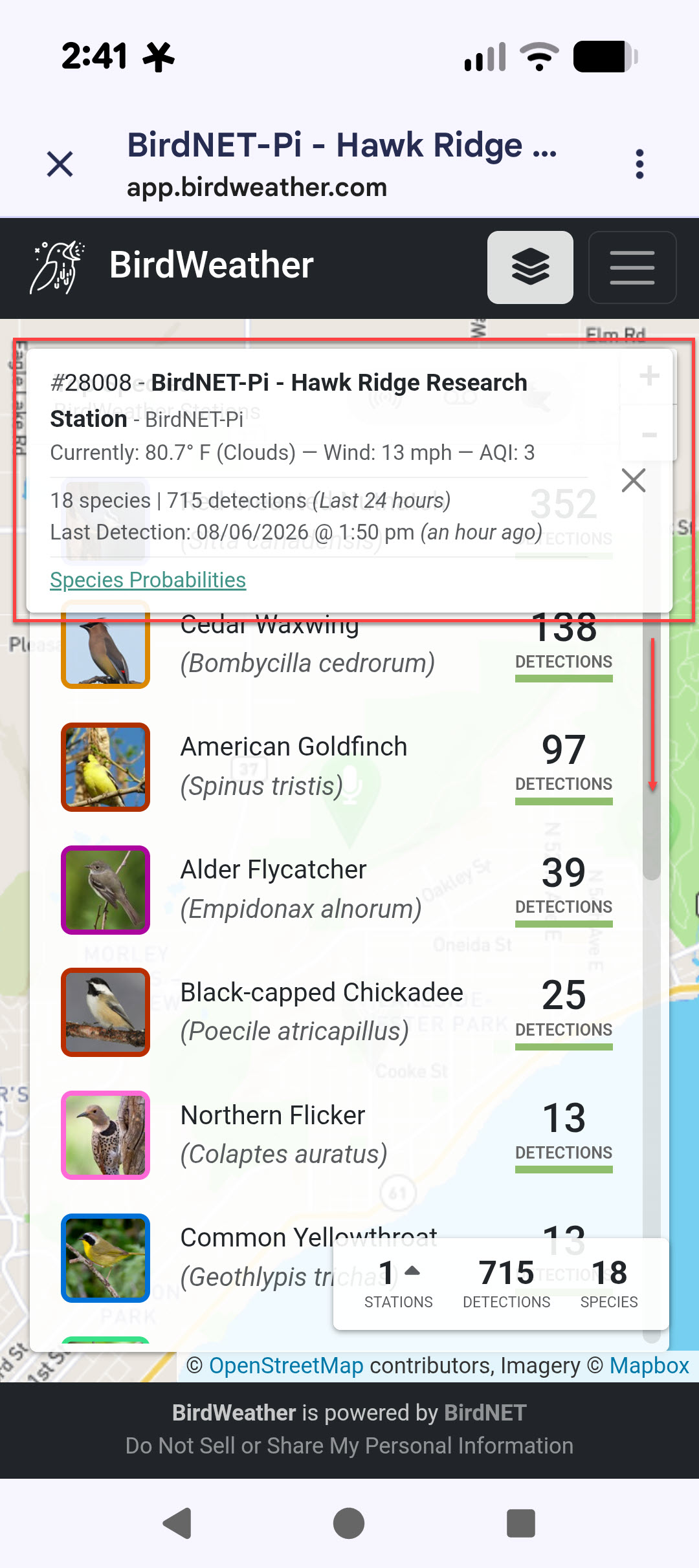
- You will know you have reached your desired station if similar information loads in the indicated box (lower left red rectangle)
- Press once upon the “layered cube icon” in the “upper right red rectangle“
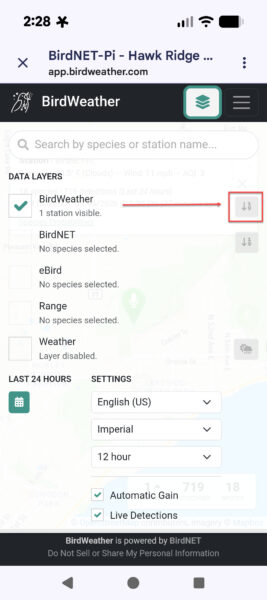
- Please note for ALL of these screenshots, the information in RED are my annotations. You will NOT see this information on your own screen.
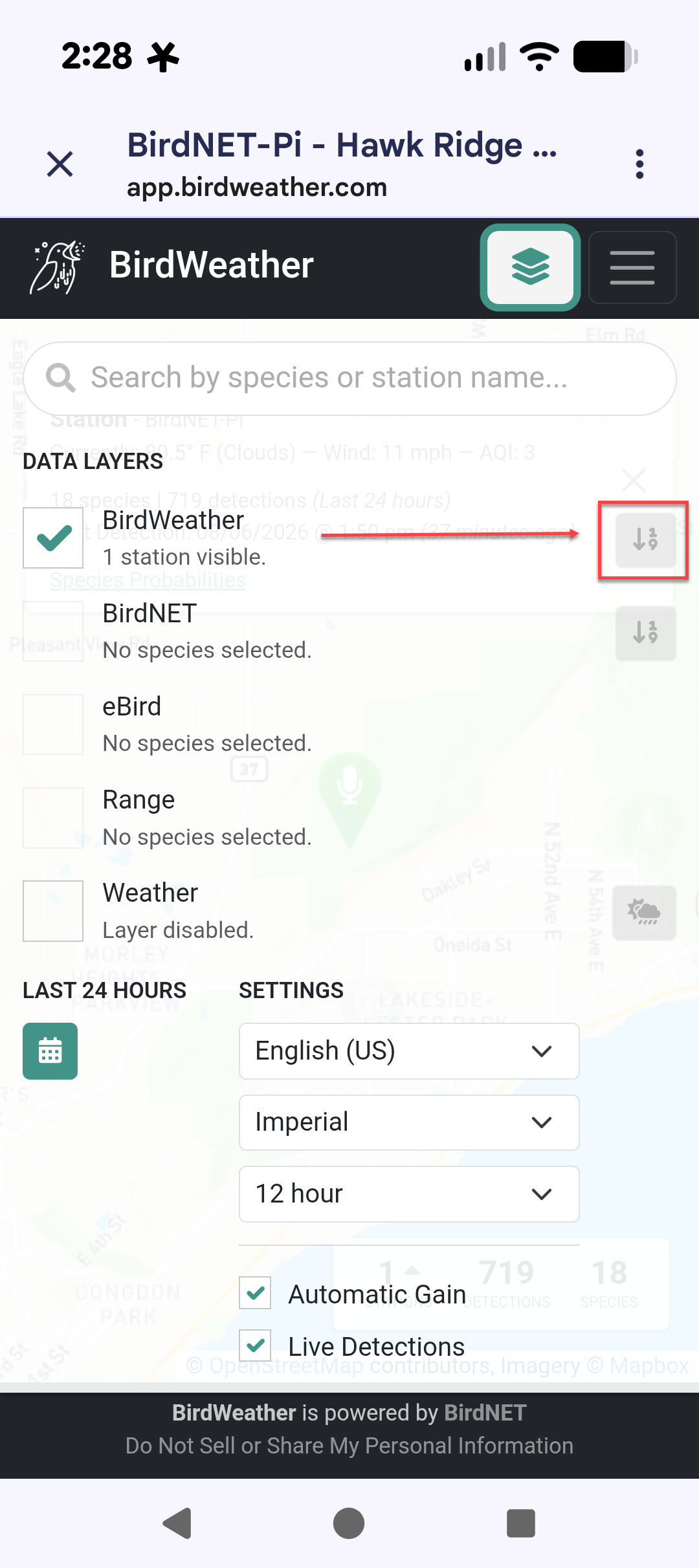
- Assuming you pressed once as indicated above, this screen will load.
- Press once on the icon shown in the “red rectangle”
- A screen similar to the one shown here should load.
- Bird information will vary as each station ID’s different birds per time period
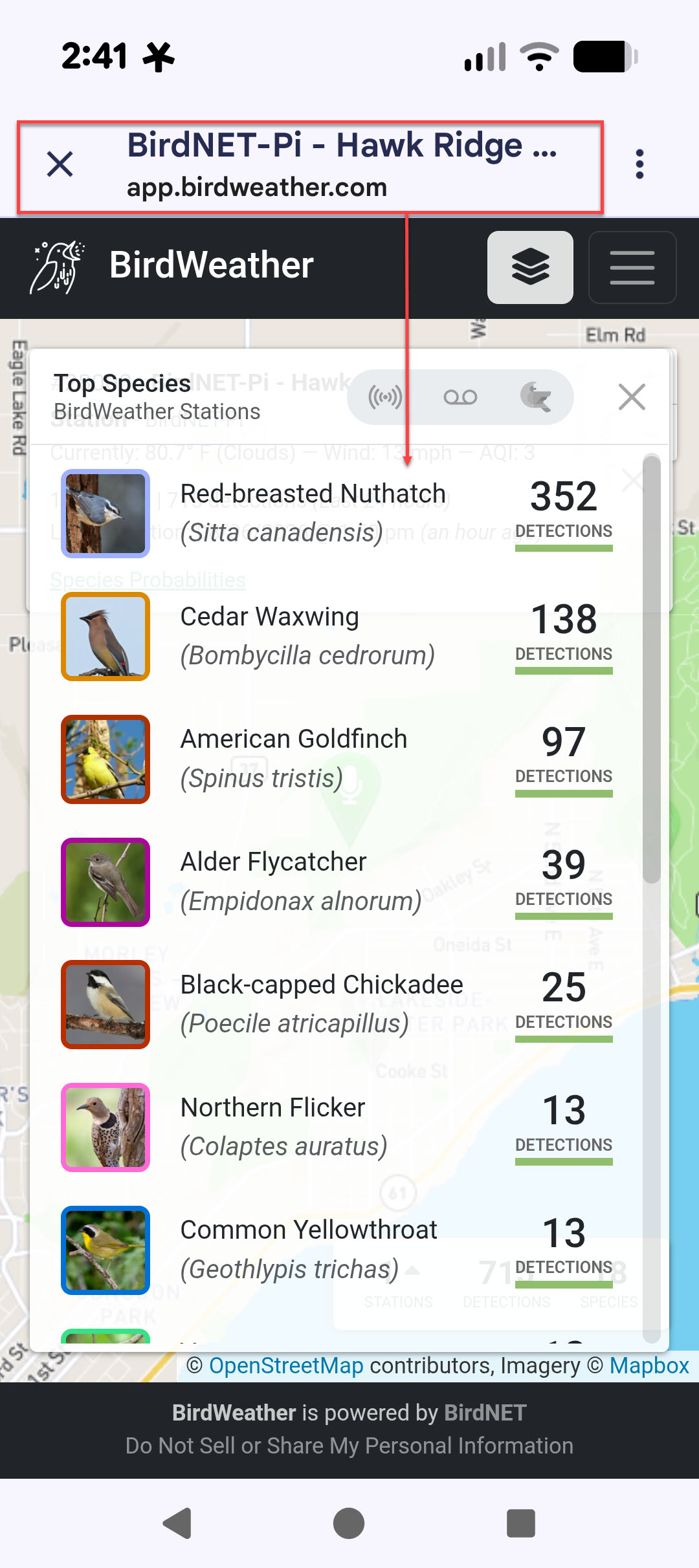
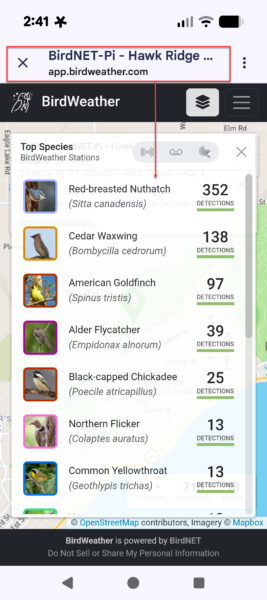
- Press once anywhere EXCEPT within the “red rectangle”, but in the region including the list of birds. This will remove the information box and allow you to view & scroll ONLY the bird list.
- Here is the resulting bird list WITHOUT the informational box. If you do NOT want to listen to actual birdsong calls recorded by the station in question, just scroll up and down … review the bird list and number of occurrences. You are done at this point.
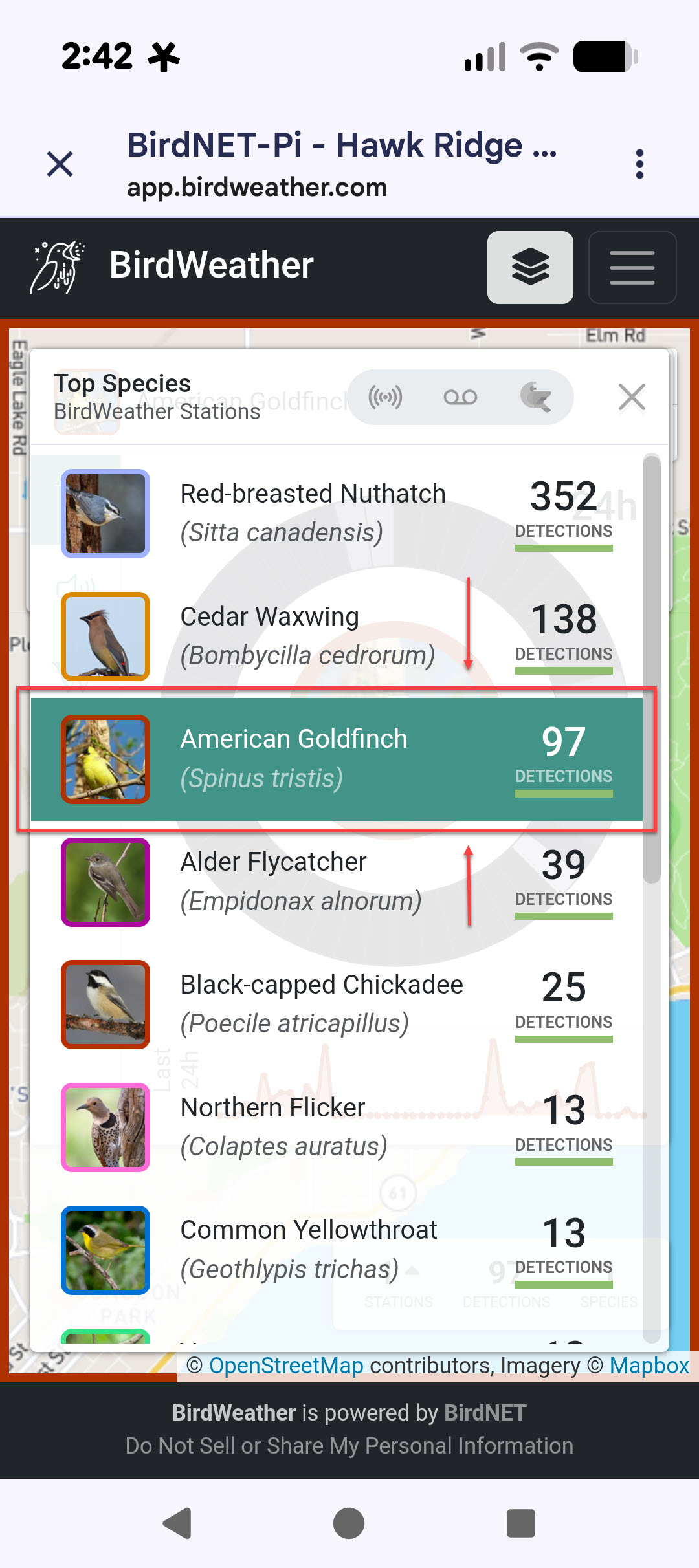
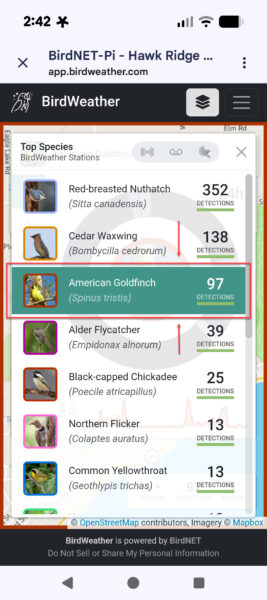
- However, if you want to listen to birdcalls, press firmly ONCE and ONLY ONCE on any given bird species.
- For this example, I pressed upon the American Goldfinch
- This is the screen where I am pressing upon the “American Goldfinch”. Have patience. This is a large database and it may take a while for specific birdcall information to load.
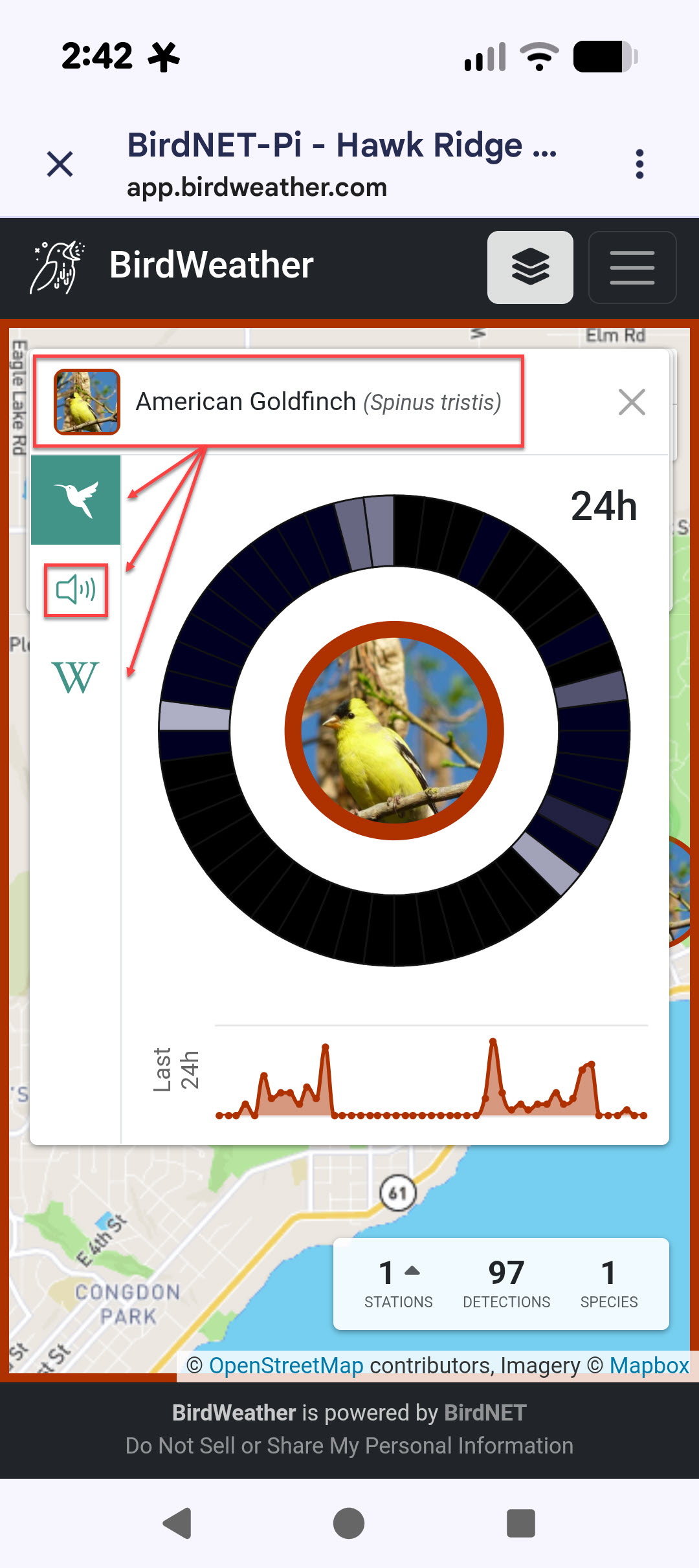
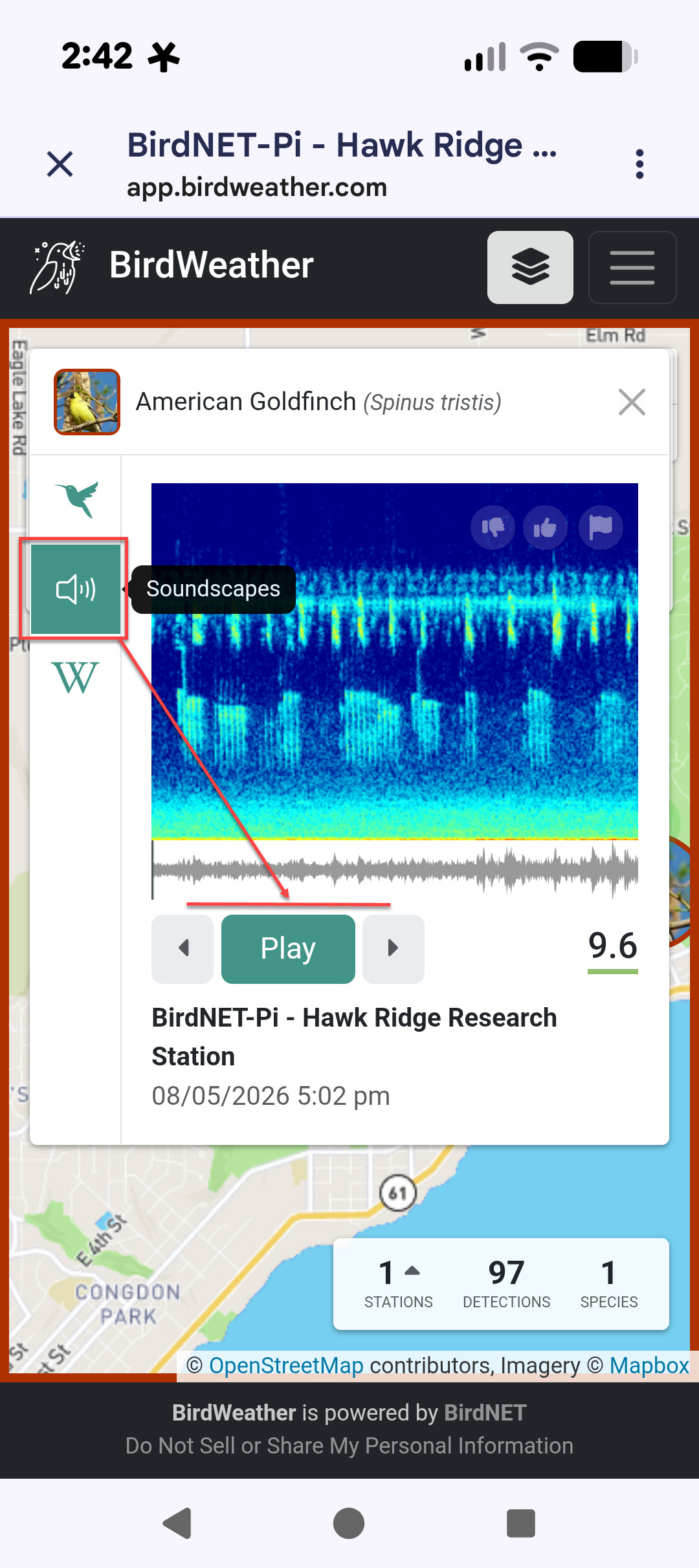
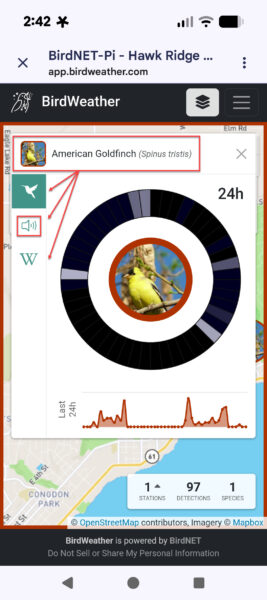
- A new screen loads with information that pertains ONLY to the American Goldfinch and is specific to the Hawk Ridge Research Station BirdNET-Pi. You have three options.
- The screen defaults to the 24 hour distribution of American Goldfinch
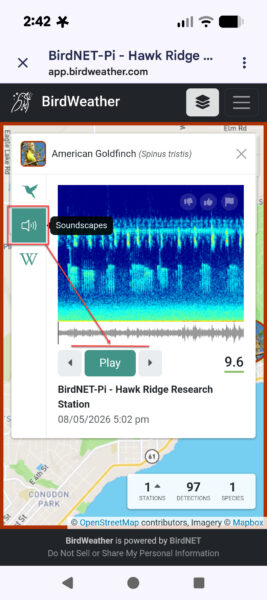
- The second option allows you to access the unique birdcalls
- The third and final option links to information about the bird via Wikipedia
- For my final part of this demonstration, I selected (pressed firmly once and have patience) the birdcall options.
- Use the “Play” button to listen to a unique call. Use the “forward” and backward” arrows to access more Goldfinch calls from this 24 hour period. The number of calls will equal the number of birdcall ID’s. The service can be slow to load each instance. I find reviewing information in the very early morning (6:00 am Central Time) to be much faster. The database / service can slow down as more of the United States wakes up.
End of Post. Remember, you may use this method via a phone for any BirdWeather station located throughout the world!