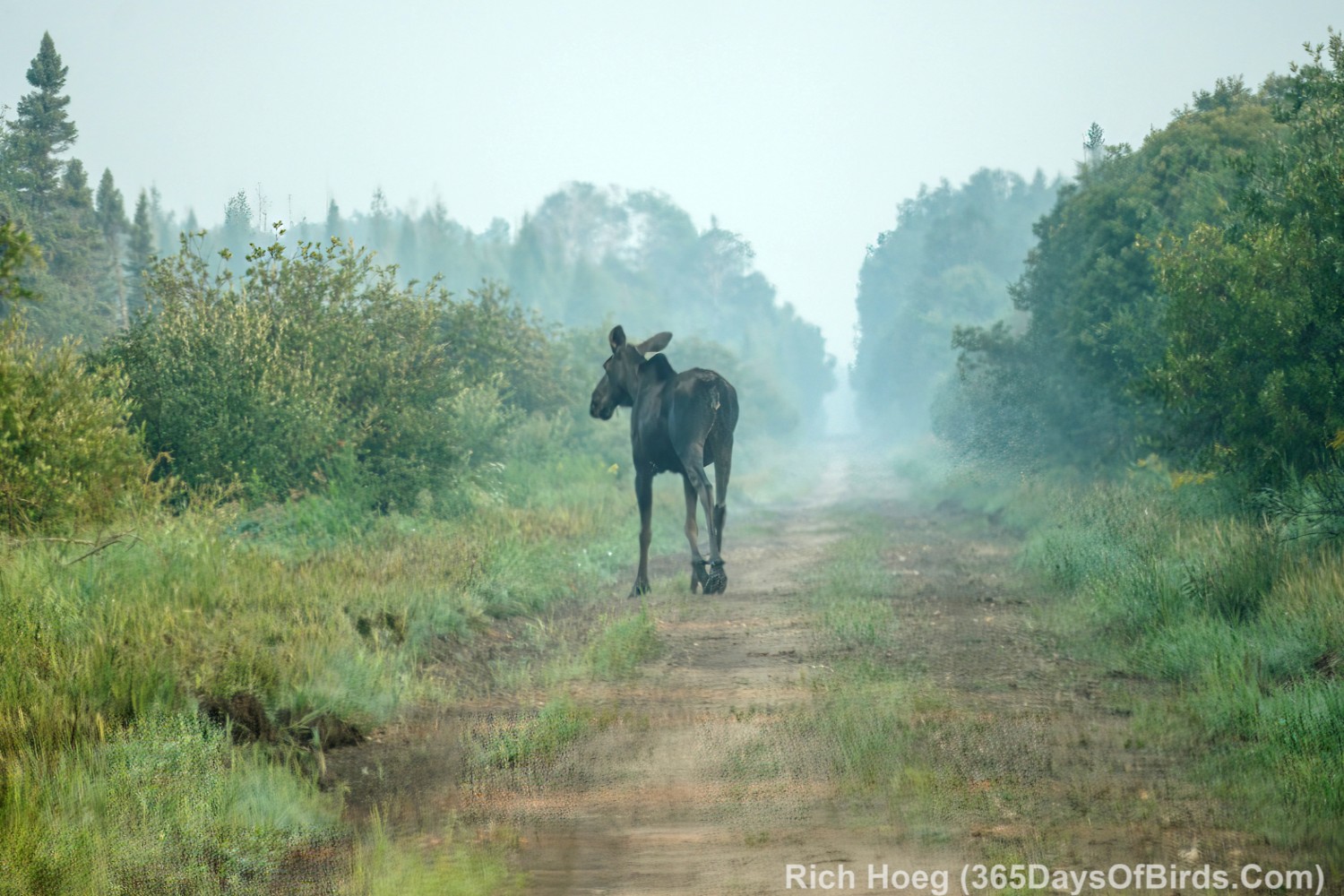
The smoke continues … The wildfires up in Ontario and Manitoba are sending their smoke down to Minnesota, and the skies are gray. Heck, you can smell the smoke at ground level.
Thus, I give you smoked moose. I saw this grand lady up on Toomey Williams Forest Road two mornings ago. Seeing and photographing the moose was my consolation prize. Only a few minutes before I had a “lifer”.
My lifer … As I drove along this remote forest road, I saw what I thought was a clump of dirt. No!!!!! There was a timber wolf cub / pup cuddled up and sleeping or keeping warm at sunrise (it was 37F outside). I did not recognize it as a mammal first, and unfortunately flushed the little guy. The young wolf ran across the road only ten yards in front of me and disappeared into the forest. Amazing sight!
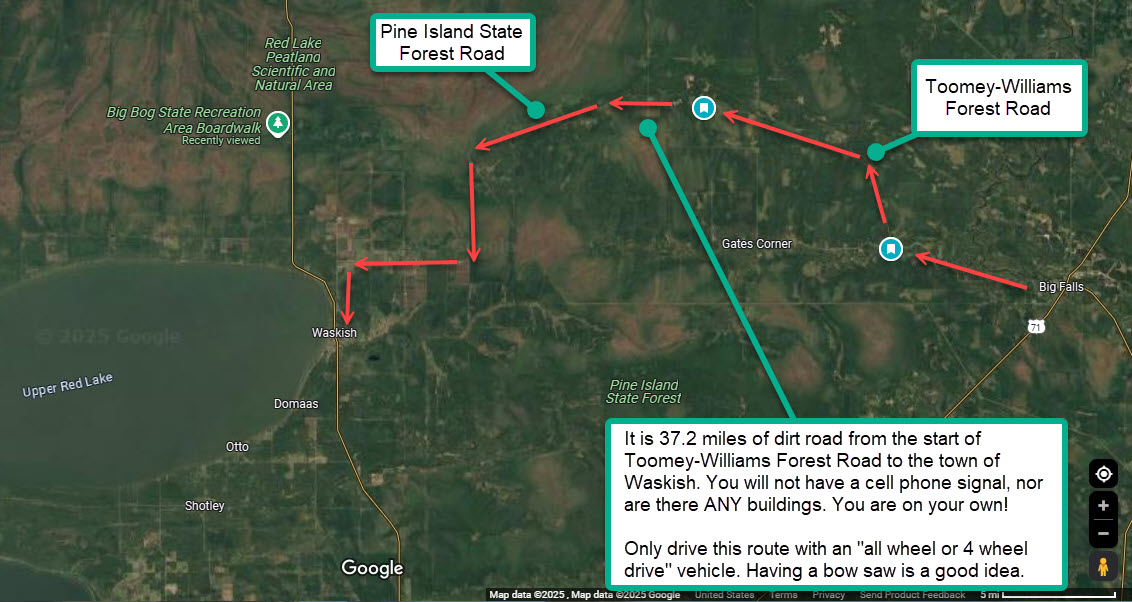
This post documents one of my favorite wilderness tours … from the town of Big Falls, Minnesota (a bit south of International Falls & the Canadian Border) to the town of Waskish, Minnesota (on the shores of Upper Red Lake). Your route will take you through amazing wilderness, and your drive will be on dirt roads for 37.2 miles from the start of Toomey-Williams Forest Road to Waskish.
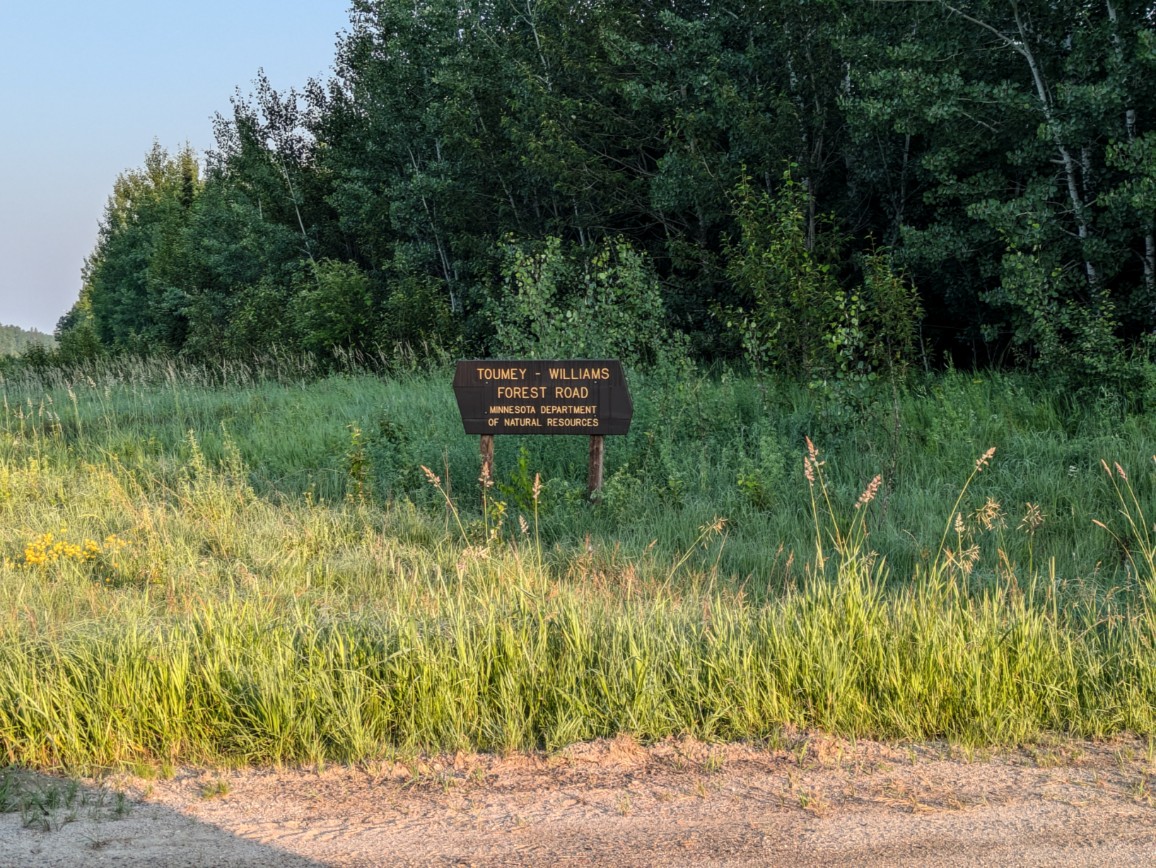
Please note eBird spells Toomey-Williams in this manner … “Twomey-Williams Forest Road.” I am using the Google Maps spelling. You will find other spellings, even on the sign as you turn onto this forest road.
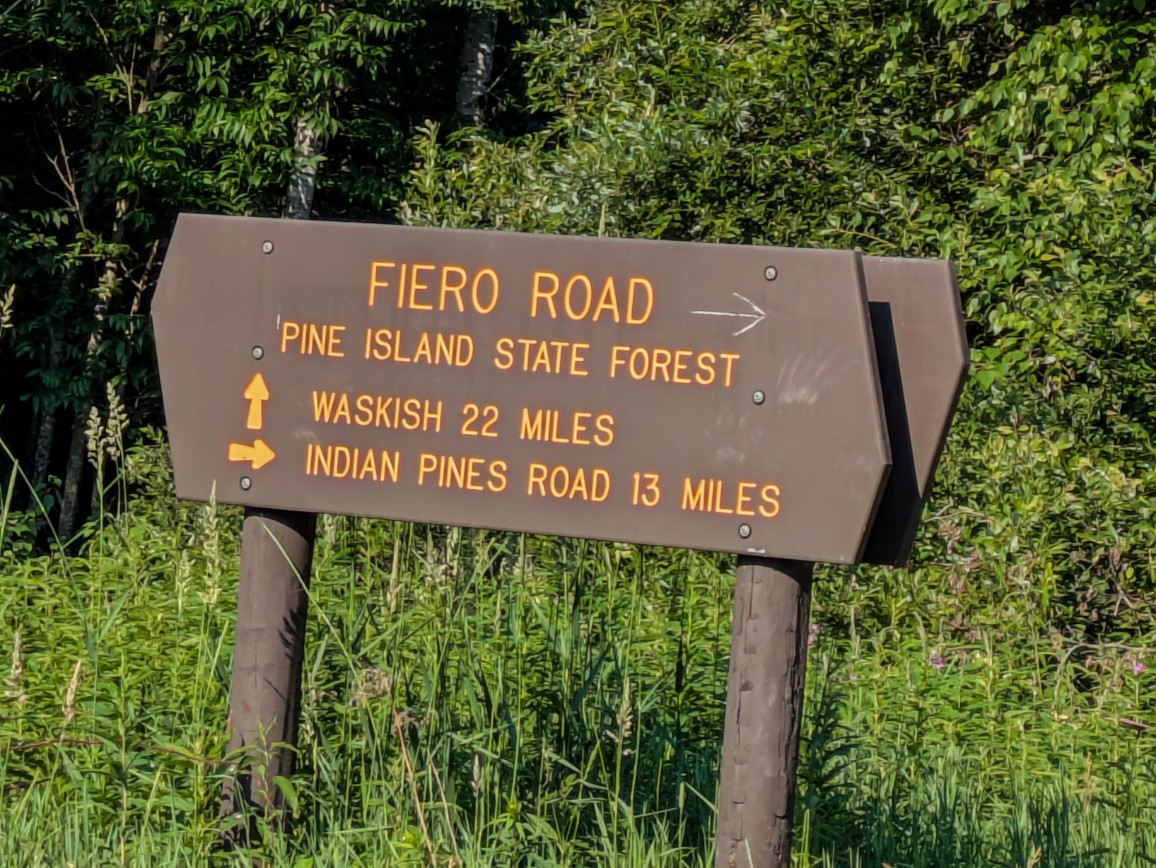
I have 8 videos which document this route. The videos were taken on the final day of June 2025. The route takes you along Toomey-Williams Forest Road, Pine Island State Forest Road (past Fiero Truck Trail) and finally to Waskish Road. Most of the habitat is boreal forest and bog. Immediately next to Toomey Williams Forest Road there will be lots of bogs, and there is a huge stretch of bog about seven miles past the intersection of Pine Island State Forest Road and the Fiero Truck Trail. Your drive will end driving through rice farms as you approach Waskish. The topography is very flat … thus the bogs.
I have a small Northwoods cabin on North Star Lake near Marcell which gives me easy access to this region. For everyone else, there is a humble, but clean motel named the TimberWolf Inn just north of Marcell (has a restaurant) which would give anyone easy access to the Pine Island State Forest.
This post assumes you will be driving this route in the early morning, and thus will have the sun behind you for most of your birding expedition (easier to see and find birds / wildlife). Upon reaching Waskish you will find gas stations in both Waskish and Kelliher (sixteen miles to the south). If you are returning to the Marcell area (Timberwolf Inn) use Google Maps, and you will be routed back with your first turn taking place off Mn #72 at Kelliher. I do NOT suggest doing this wilderness route in reverse unless you wait till well into the afternoon and get the sun behind you.
Pay attention to these warnings!
You will not have cell phone coverage
The road can be soft. Only drive this route with an “all wheel or 4 wheel drive” vehicle. After heavy rains the roads may be difficult driving for any vehicle.
There is no civilization … no buildings … no cabins … no help if you break down or get stuck (no cell phone coverage over most of the route). I carry a bow saw in my car to cut through trees that may have fallen across the road.
This route is not plowed in the winter
The bogs and forest are fantastic. Wildlife abounds!
A basic map of the route … click to expand
Here are interesting links and web content: (click or press upon to maximize images)
I am helping out with a Broad-Winged Research Project this summer, and you may help me help both northern Minnesota’s Hawk Ridge and Pennsylvania’s Hawk Mountain‘s research efforts (Learn more about Broad-Winged Hawks via the Cornell School of Ornithology). This beautiful raptor’s population population has fallen 16% out in its eastern range since 1980’s. Thankfully here in the Central Flyway populations appear to be stable, and perhaps even rising. This Broad-Winged Hawk Research Project will be one of the first extensive studies of this bird specie. It is hoped to band many of these hawks with transmitters that will let us follow their migrations and learn more about where they truly winter in Central and South America … perhaps leading to habitat preservation along their migration paths and wintering habitats.
In the past week I have personally identified eleven Broad-Wing breeding territories with GPS coordinates … including one actual nest! How can you help? If you discover Broad-Winged Hawk Nests this summer in the Northland please contact me (Richard.Hoeg@GMail.Com). I will need both the GPS coordinates and a description of the nest site. I promise NOT to share the nest location to eBird or any other individuals OTHER than the research staff from Hawk’s Ridge. If the nest is on private property we will need permission to access the given location.
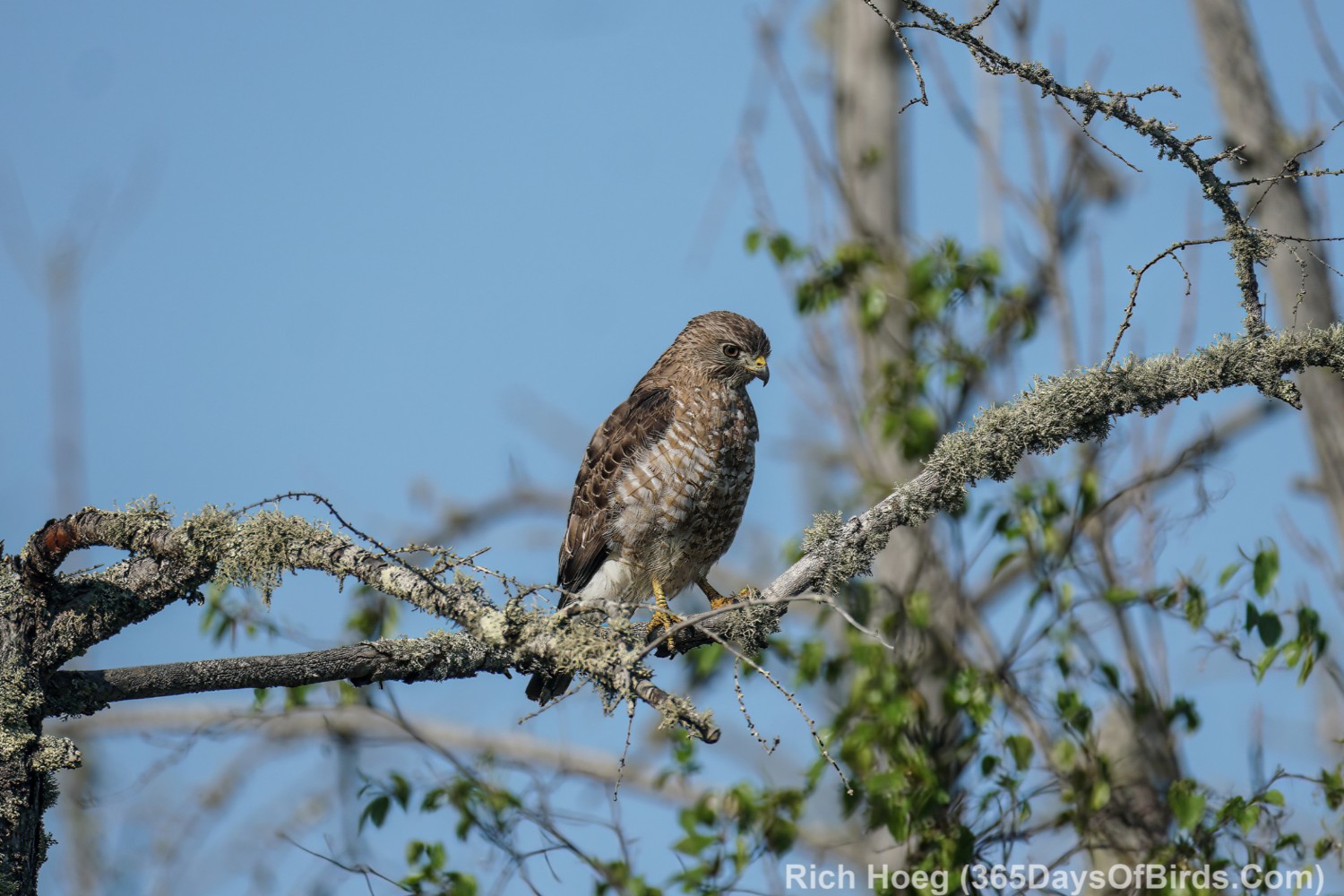
Here is the Broad-Winged Hawk I have seen twice within the past few days near Sax-Zim Bog’s Welcome Center and Overton Road.