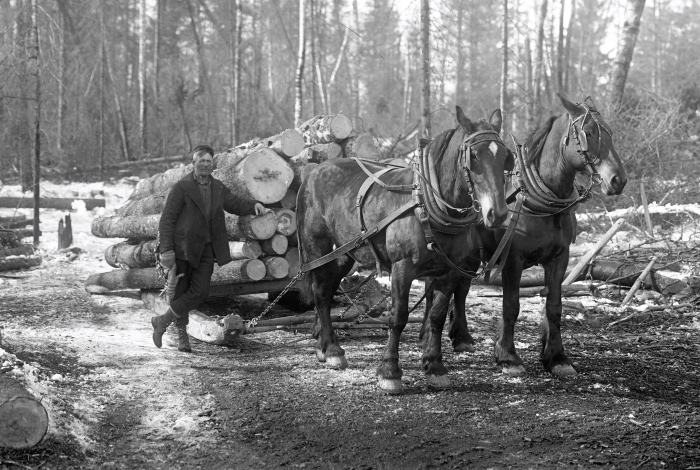
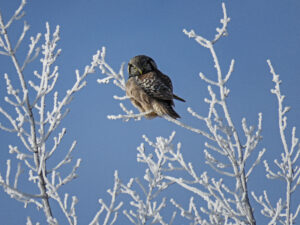
While I don’t want to turn this blog into a northern Minnesota tourist guide, I know many of you have family members who couldn’t care the least about our fine feathered friends. Thus, I like to add an occasional post about things one might do to the entire clan happy when visiting / birding northern Minnesota. Today’s topic is “Logging in Days of Yore!”
It is definitely worth a stop at the Minnesota Historical Society’s Forest History Center in Grand Rapids. The “center” is an old logging camp built on the shores of the Mississippi River. The folks you will find at the Forest History Center are primarily Minnesota Historical Society employees who believe passionately in helping you learn the history of the region. Northern Minnesota was essentially clear cut in the early part of the 1900’s.
Take the time to watch this short video about the last log drive on the Little Fork River (a bit north of Grand Rapids). This log drive took place in 1937 not too far from my cabin. My thanks to the Minnesota Historical Society for posting this video a few days ago to their YouTube channel. (video link for blog email subscribers)
Also a bit north of Grand Rapids is the only remaining Civilian Conservation Corp Camp in the Lower 48 which is in remotely good shape: Camp Rabideau. All the hiking trails I use near my own house were built by the CCC in the 1930’s. If you would like to read about the logging industry in northern Minnesota, here is a great overview from the Minnesota Historical Society. The picture is theirs, not mine.
As a fyi … Molly and I returned from Iceland last night, and given the time change I have been up since 3:30 am. More Iceland posts will be coming once I work through my backlog of photographs!
This post is reworked from a similar effort I wrote many years ago. The new edition is driven by the log drive video becoming available.
Posts have been somewhat more infrequent recently on 365DaysOfBirds. I have been working upon a HUGE project to archive content from my old website, NorthstarNerd.Org. This project was forced by the impending shutdown of a hosting service I have used since 2006. I had maintained my old site as an archive to my 28+ years as a web development / software project manager with Honeywell. My projects stretch back to the earliest days of the internet, and I often blogged about the world wide web and knowledge management. Eventually my “new” NorthstarNerd.Org web site will have all my old content.
For the moment, if you are interested, you may use these links from the Internet Archive’s WayBack Machine to see my earlier content. Please note, the WayBack Machine can be slow to load content …
Here are the first archived posts from the old NorthstarNerd.Org archive. An additional 500 blog posts in PDF format will be added during October and November.
Post Edit … One Year Later in 2026: I have now purchased a thermal monocular. You may wish to follow my journey as I discover whether this was a smart decision. Initial Blog Post from just prior to my new thermal arriving.
I have been trying out a friend’s thermal monocular for a few days. These devices have made amazing advances in the past few years both in terms of capabilities and price drops. While I am NOT recommending the purchase of this device, the Topdon TS5004, that is not because I was not impressed with the thermal vision scope. I was impressed. Let me explain …
From a practical standpoint because of the high prices that had to be paid to obtain decent thermal imaging, thermal scopes used to only be available for the military. For us “non soldiers” the cost did not justify the price. However, prices have fallen dramatically. As of today, the Topdon TS5004 can be bought for around $400 (Amazon link … for your benefit … not sponsored).
My tests involve multiple trips into the forest to try out the device on Les and Amy, my resident Great Horned Owls. Given Amy has now nested, I always knew where she was located; and both afternoons that I spent hiking right before sunset, I knew where Les was perched. Thus, I cheated. I already knew where two owls were located, which allowed me to easily test the thermal scope. Amy lit up like a Christmas tree. Compared to her surroundings the scope showed that something was definitely throwing off all kinds of heat … infrared light. However, I could NOT tell that what I was seeing was an owl:
I was close to the nest … within 30 yards, but obviously not up in her nest tree
Amy was the ONLY item within my field of vision with a heat signature. This would not be unusual in the Minnesota forest in the middle of the winter. It is a tough environment. Not a lot of life can survive our extreme winters. It is actually -18F right now as I type out this post at 6:00 am … long before sunrise at 7:20 am. Thus, the scope definitely made it obvious something was alive within my field of view.
I have talked about “field of view”. The Topdon has a narrow field of view. In its best quality mode there is zero magnification, but still a narrow field of view. It does have digital zoom of 2x, 4x, and 8x, but you would never be able to uses those magnifications if you were in a search mode (i.e. you did not already have some object pre-located upon which you wanted to zoom the monocular)
I also looked for Les, the male Great Horned Owl, which I knew was perched on the other side of a very tall white pine. Although I knew the bird was at the top of the tree, the thermal scope could not tell something was perched on the other side of a large tree trunk … not surprising or unexpected.
In my estimation a thermal scope will not assist your birding efforts. It obviously can not be used while driving. Even upon stopping, the field of view is small. A better use of your time and resources will be to better learn bird habitat, and invest in a really good pair of binoculars. I like Nikon Monarch binoculars. Good binoculars have a decent field of view, and allow you to quickly scan thick cover for birds.
I have, however, seen some cool thermal scope setups. A local bird guide has two scopes mounted outside his car pointing towards each side of the road, and the scopes are in turn each connected to tablets within his car. Thus, this guide can drive roads slowly and obtain the benefits of thermal scopes. Please understand these scopes do not work through glass; they must be outside. Understand that thermal scopes definitely work during the Minnesota winter. The heat difference makes living animals jump out even in daytime. During summer months, or in warmer climates these devices may not work as well during daylight hours.
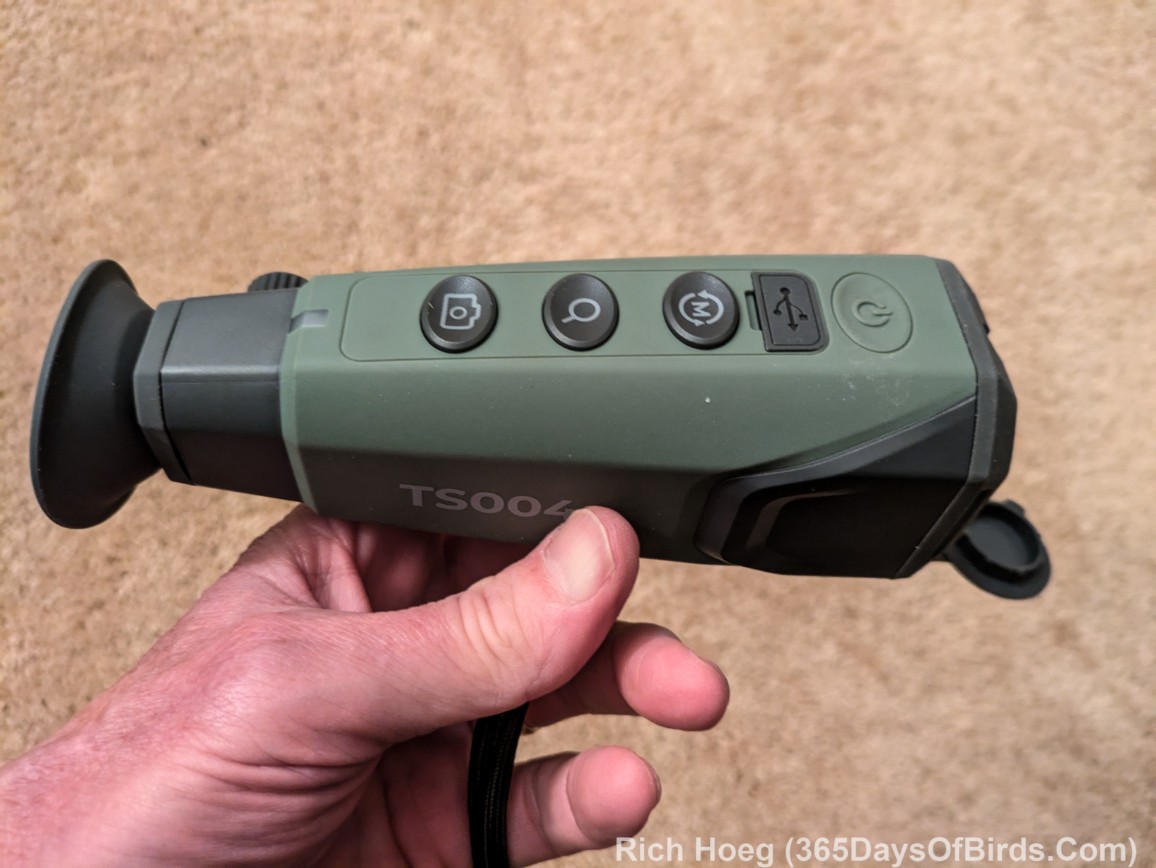
Here are a few more links, videos and an image which will allow you to learn more about the Topdon TS004. Once again, for the price I am supremely impressed with the technology obtained for the price, but I personally would not yet find one useful. My Topdon photo shows you my hand because I wanted everyone to understand the size of the thermal scope. My image shows the device is not complex … only four buttons: Power, Mode (different kinds of light displays), Magnification and Picture. {this device does NOT take good night photos … it is a scope, not a camera}
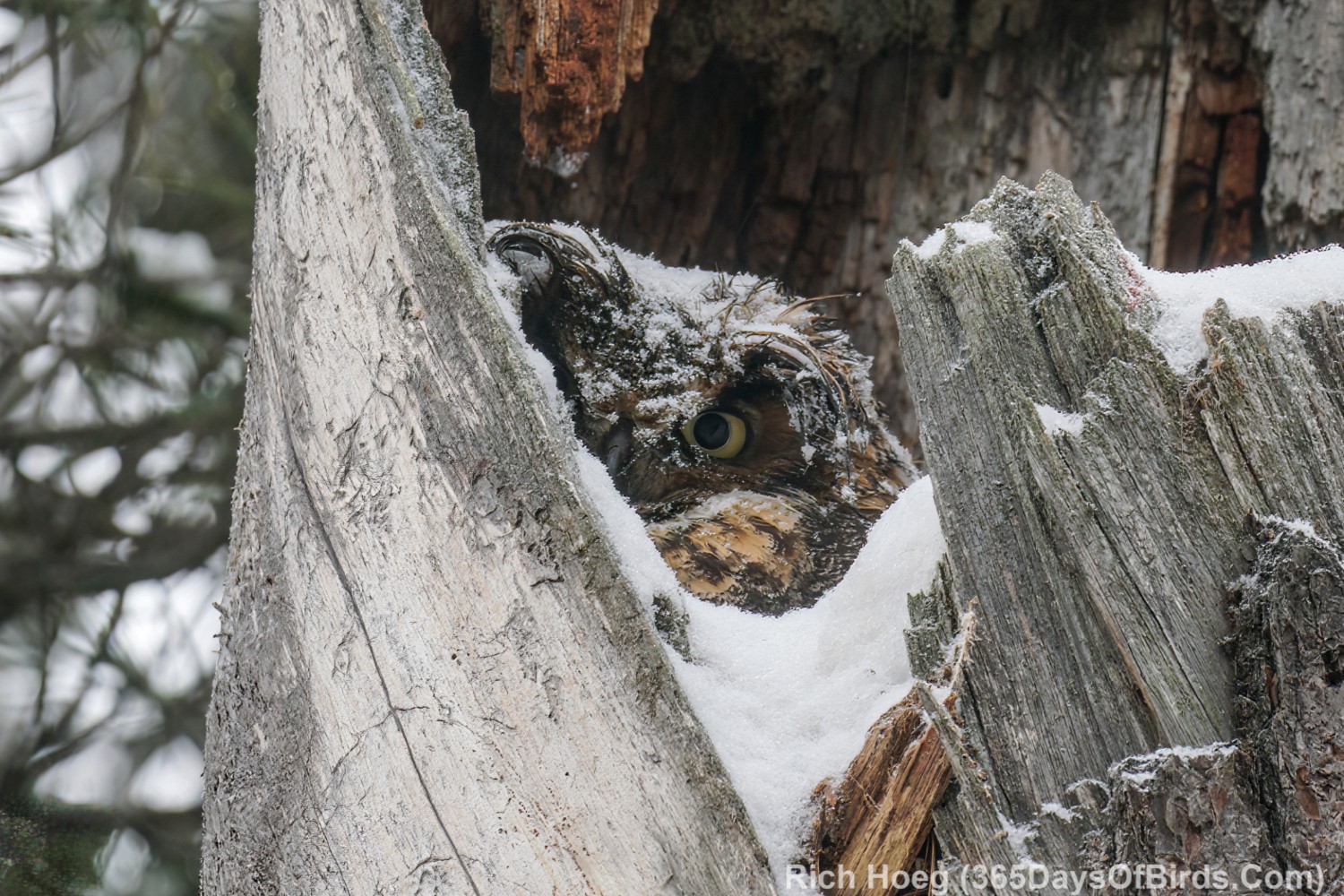
If you would like to learn more about Les and Amy, my local Great Horned Owls, including downloading a free PDF version of the children’s picture book I authored and photographed about their owlets, browse to this page on my website. Amy is pictured immediately below. The image was taken at exactly the same distance as from where I evaluated the thermal monocular, but with a 350 mm zoom lens on my Sony A6300 (530 mm full sized sensor equivalent)
Thank you for visiting 365DaysOfBirds. Rich Hoeg, the owner of this blog loves nature. You will never find a single advertisement, sponsored link or pop-up on this site. Learn more about Rich and his quest to bring the outdoors to his readership.